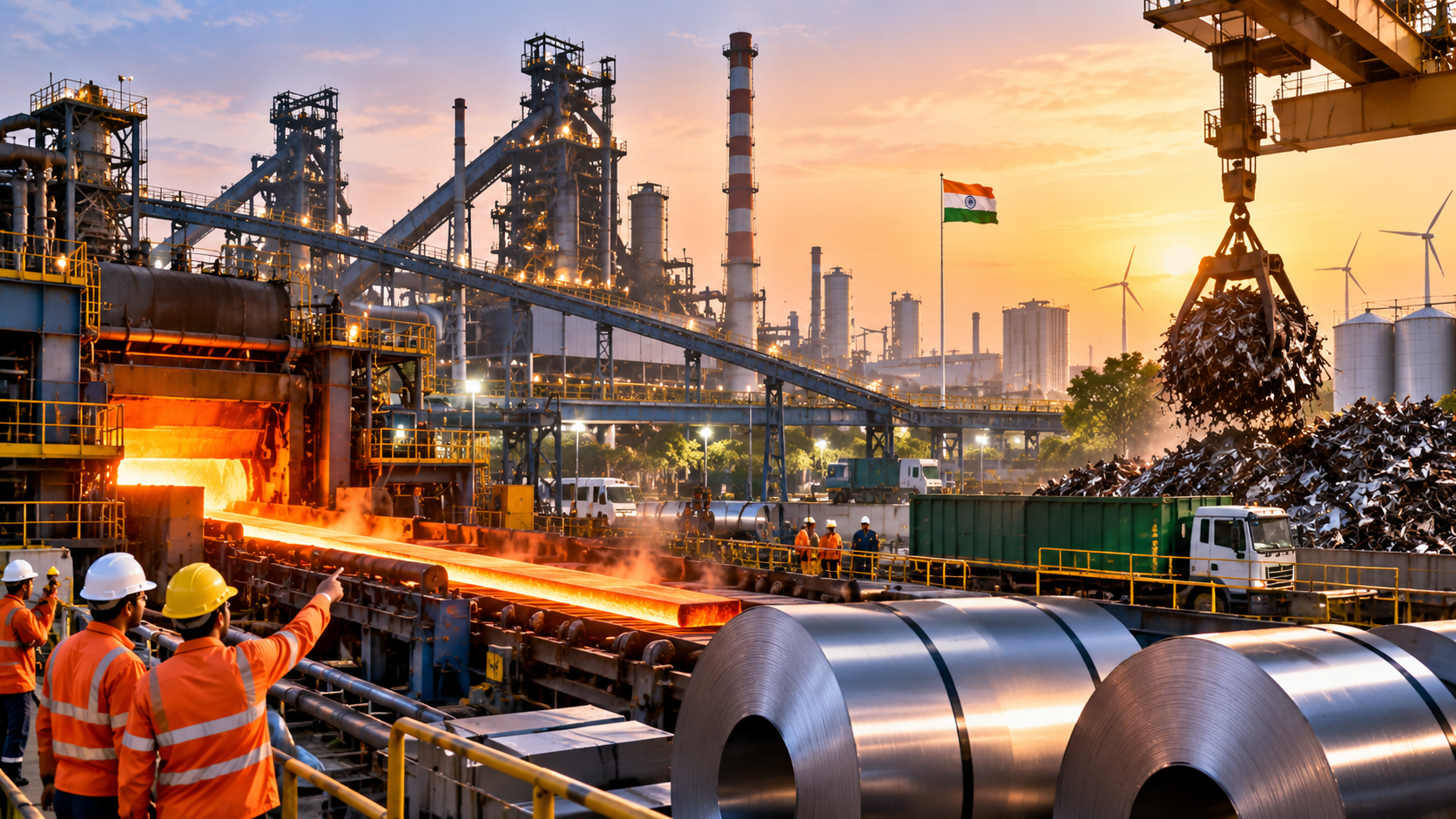
The proposed National Steel Policy 2047 aims to raise India’s crude steel capacity to 604 million tonnes, promote a circular economy, increase value-added production and sharply reduce the sector’s carbon emissions.
New Delhi, October 18 — The proposed National Steel Policy 2047 is expected to promote a circular economy, higher value-added steel production and decarbonisation across India’s steel industry, according to sector stakeholders.
The government has released the draft policy with a long-term target of increasing India’s crude steel production capacity to 604 million tonnes by 2047.
The policy also projects finished steel demand of 505 million tonnes, while per capita steel consumption is expected to rise to 302 kg by 2047.
India’s steel exports are targeted to reach around 45 million tonnes under the proposed roadmap.
Industry executives said the policy’s focus goes beyond simply expanding production capacity and includes raw-material security, recycling, speciality steel, technological modernisation and support for secondary steel manufacturers.
Pankaj Malhan, Managing Director and CEO of RHI Magnesita India, said recognition of refractory recovery and magnesite raw-material security demonstrates a broader approach towards creating a more resilient and competitive steel ecosystem.
He said the industry remains committed to increasing refractory recycling, circular-economy initiatives and investment in India.
BMW Industries Managing Director Harsh Bansal said the draft policy addresses multiple aspects of the steel sector, including increasing value-added and coated steel production and supporting secondary steel players.
Decarbonisation is another major focus.
According to Rajib Maitra, Partner at Deloitte India, the policy envisages reducing the steel sector’s average carbon emission intensity from around 2.54 tonnes of CO₂ per tonne of crude steel to approximately 1.54 tonnes by 2047, through a four-phase transition.
Kamdhenu Group Chairman and Managing Director Satish Kumar Agarwal said capacity expansion, raw-material security, technological modernisation, speciality steel and decarbonisation could create significant opportunities for integrated and secondary steel producers.
The policy also highlights the role of smaller downstream manufacturers.
PS Raj Steels Managing Director Deepak Kumar said support for manufacturing clusters and MSMEs will be important because they account for nearly 60% of India’s flat stainless-steel capacity.
The draft National Steel Policy 2047 therefore seeks to combine rapid capacity growth with higher-value production, recycling, cleaner technologies and greater competitiveness.