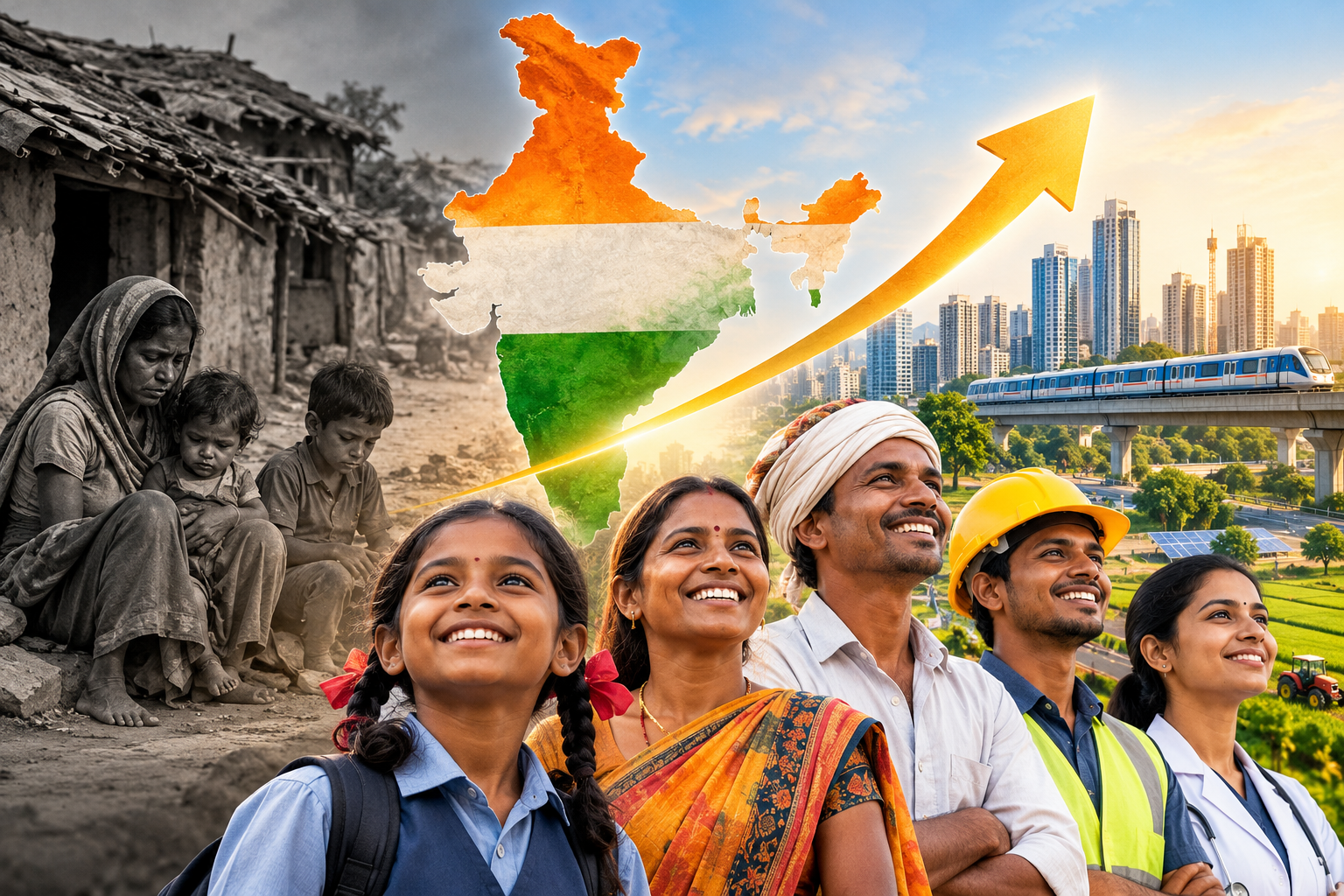
The World Bank says strong consumption growth, rising employment and expanded social welfare programmes helped India achieve one of the world’s fastest poverty reductions, although income inequality and youth unemployment remain concerns.
Highlights
- India’s extreme poverty rate declined from 27.1% in 2011 to 2.6% in 2023.
- Around 496 million people moved above the $4.20-a-day poverty threshold.
- Poverty at the $4.20 threshold fell from 57.7% to 16.1%.
- Employment increased by approximately 134 million between 2017 and 2023.
- Uttar Pradesh-to-West Bengal belt accounts for about 57% of India’s poor population.
- Youth unemployment increased from 14.6% to 15.9% between Q1 FY26 and Q1 FY27.
Full Story
New Delhi, October 30, 2026: India has recorded a sharp decline in poverty over the past 12 years, with the extreme poverty rate falling from 27.1% in 2011 to just 2.6% in 2023, according to a new World Bank report.
The India Poverty and Equity Brief: October 2026 estimates that approximately 496 million people escaped poverty between 2011 and 2023, based on the lower-middle-income poverty threshold of $4.20 per day at 2021 purchasing power parity (PPP).
The share of India’s population living below this threshold declined from 57.7% to 16.1%, marking one of the fastest reductions in poverty globally.
Poverty Expected to Decline Further
The World Bank projects that poverty at the $4.20-per-day threshold could decline from 14.2% in 2026 to 12.1% by 2028.
However, these projections are indicative and may change with updated economic and employment data.
Multidimensional poverty also declined significantly, from 53.8% in 2005-06 to 16.4% in 2019-21, according to the Oxford Poverty and Human Development Initiative.
Employment and Welfare Schemes Drive Progress
The report attributed India’s poverty reduction to stronger household consumption, rising employment, particularly among women, and expanded social transfers, including food subsidies.
Employment increased by approximately 134 million people between 2017 and 2023, with rural women accounting for a significant share of new workers.
Finance Minister Nirmala Sitharaman welcomed the findings, saying the government’s sustained policy efforts under Prime Minister Narendra Modi were strengthening inclusive growth and economic opportunities.
Poverty Remains Concentrated in Certain States
Despite nationwide improvements, poverty remains geographically concentrated.
According to the report, states in a belt stretching from Uttar Pradesh to West Bengal account for approximately 57% of India’s poor population.
The World Bank highlighted the need to expand productive employment opportunities in these regions to sustain poverty reduction.
Income Inequality and Youth Unemployment Remain Challenges
The report also flagged persistent income disparities. In 2023, median earnings among the top 10% of workers were approximately 13 times those of the bottom 10%.
Meanwhile, youth unemployment rose from 14.6% in Q1 FY26 to 15.9% in Q1 FY27, particularly affecting young rural women.
The World Bank noted that employment growth remained concentrated in relatively low-productivity activities, while real earnings showed limited improvement.