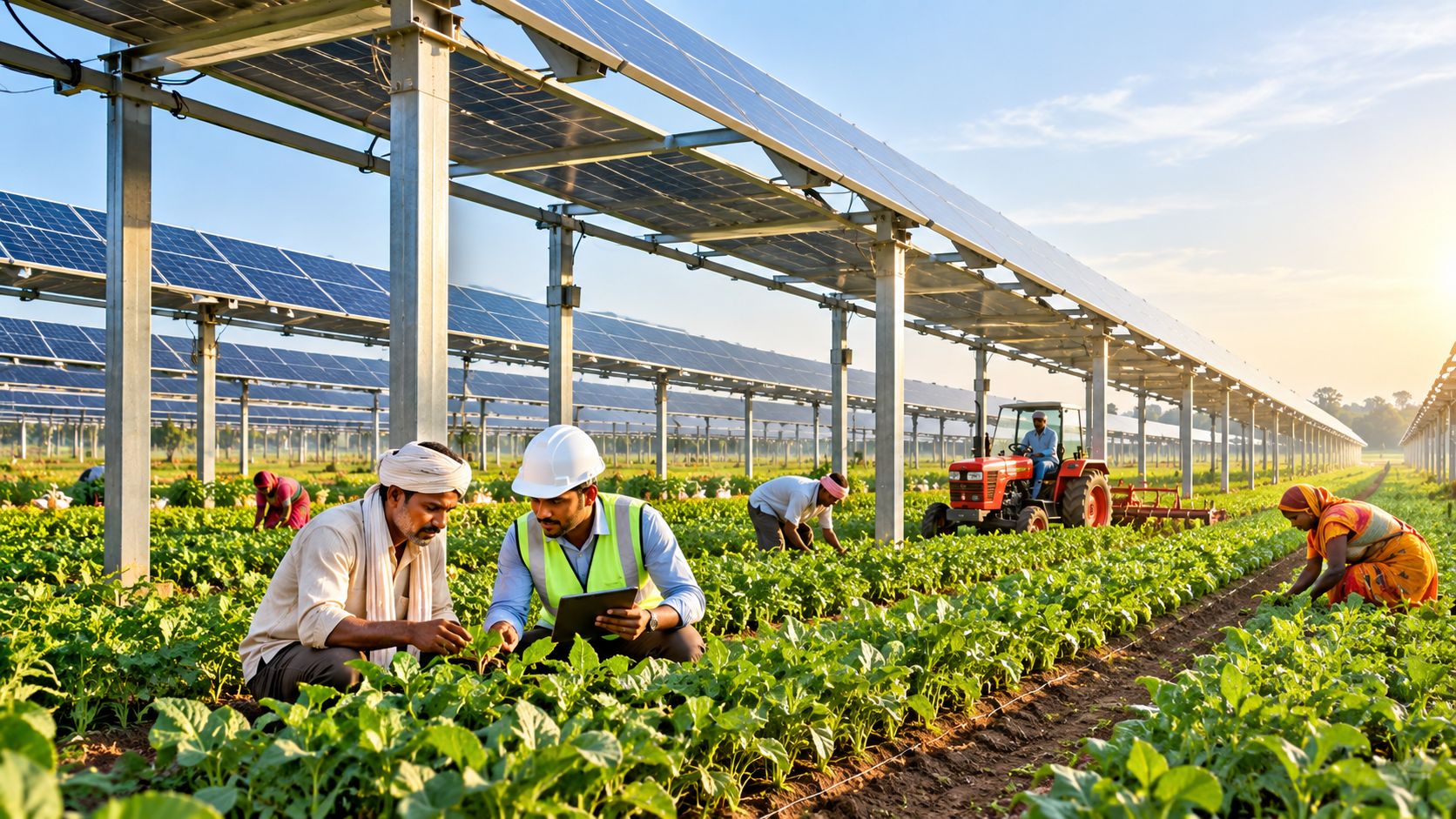
The government is preparing a national policy to promote agrivoltaics, allowing farmers to generate solar power while continuing cultivation on the same land, with an initial target of 5 GW and a proposed 10 GW component under PM-KUSUM 2.0.
New Delhi, October 22 — The government is working on a policy to promote agrivoltaics in India, with the aim of increasing farmers’ income while expanding clean-energy capacity without taking agricultural land out of cultivation.
Union Minister for New and Renewable Energy Pralhad Joshi said around 30% of India’s 160 million hectares of cropland could potentially support non-fossil-fuel projects using agrivoltaic systems.
Agrivoltaics combines crop cultivation and solar power generation on the same land, generally by installing solar panels on elevated structures so that farming can continue underneath.
Joshi said the model can also help address land-availability constraints associated with conventional solar projects.
Around four acres of land are required to install 1 MW of solar capacity, which can make conventional ground-mounted projects difficult in a country where about 85% of farmers are small and marginal.
States including Maharashtra, Rajasthan, Andhra Pradesh, Madhya Pradesh, Karnataka and Uttar Pradesh together account for nearly half of India’s estimated agrivoltaic potential.
The government is initially targeting around 5 GW of agrivoltaic capacity over the next few years.
A dedicated 10 GW agri-PV component is also expected to form part of the proposed PM-KUSUM 2.0 scheme, supporting solar installations on structures erected above standing crops.
The draft policy will be placed in the public domain for comments from states and other stakeholders before being finalised.
Agrivoltaics, however, currently costs more than conventional solar.
According to Joshi, agri-PV plants are around 25-30% more expensive than ground-mounted projects because of the additional infrastructure needed for elevated structures.
Power from mounted agrivoltaic systems can cost about ₹3.20 per unit, compared with around ₹2.60 per unit for conventional ground-mounted solar.
The minister said scaling up installations will be necessary to reduce costs and improve commercial viability.
Field studies have also indicated potential agricultural benefits.
Under suitable systems, crop yields could improve by around 10-20%, while water consumption may decline by about 30%.
Agriculture Minister Shivraj Singh Chouhan stressed that the design of agrivoltaic systems must allow farmers to continue cultivation normally.
He said panel height, spacing between structures and movement of agricultural machinery must be carefully considered so that farmers can continue ploughing and change crops when required.
India already has 16.3 GW of decentralised solar capacity, including 7.6 GW under PM-KUSUM and 8.7 GW under rooftop solar programmes, largely through the PM Surya Ghar Muft Bijli Yojana.
The government now sees agrivoltaics as another major opportunity to combine agricultural productivity with renewable-energy generation.