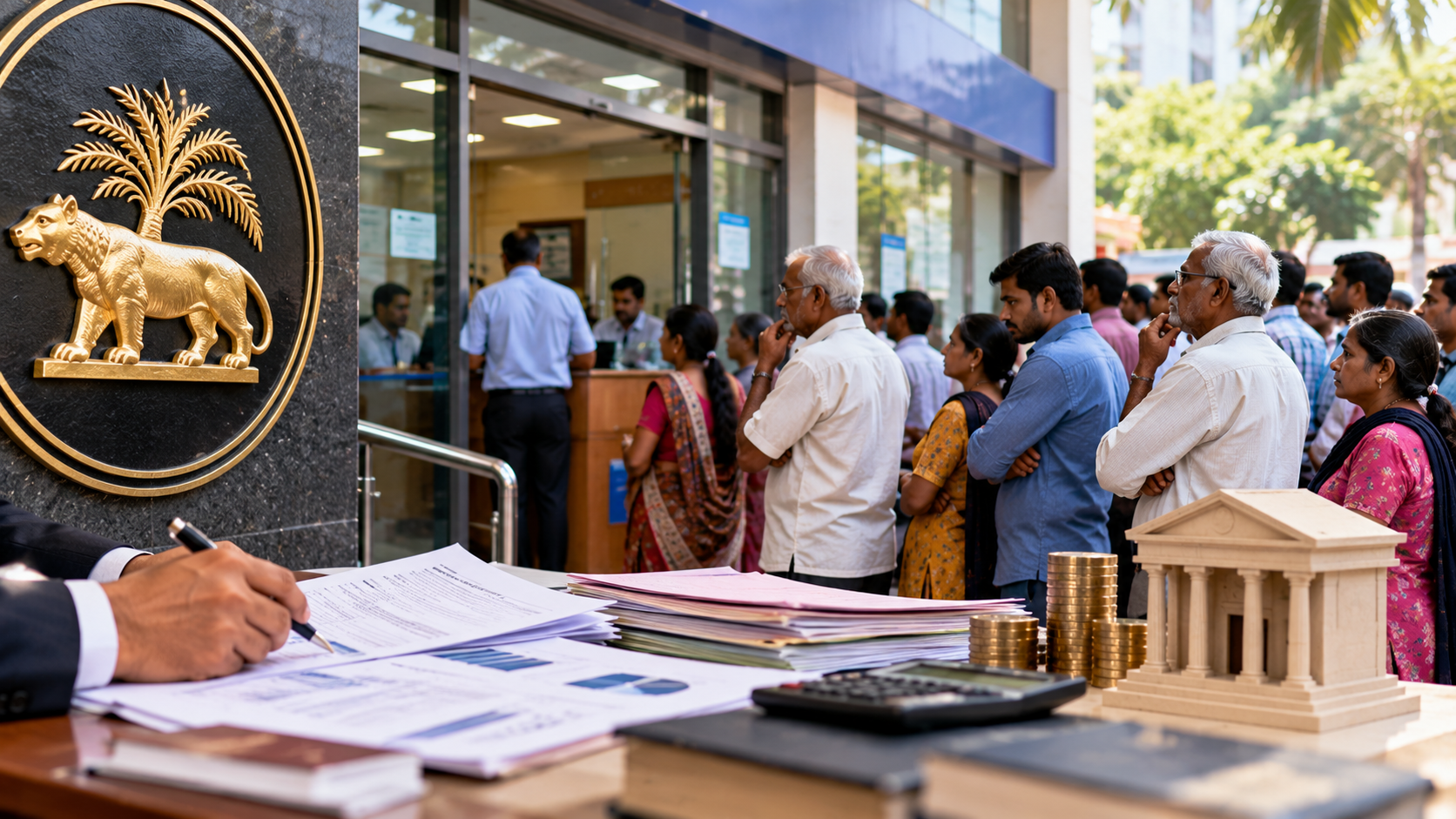
The Reserve Bank of India has imposed several restrictions on Puducherry Co-operative Urban Bank for six months, including limiting withdrawals to ₹5,000 per depositor, citing the lender’s deteriorating financial position and unresolved supervisory concerns.
Mumbai, October 21 — The Reserve Bank of India (RBI) has placed Puducherry Co-operative Urban Bank under regulatory restrictions for six months, including a cap of ₹5,000 on withdrawals by individual depositors.
The restrictions came into effect from the close of business on October 21, 2026, and will remain in place for six months, subject to review.
RBI said the action was necessary because of the bank’s deteriorating financial position and the lack of adequate corrective measures despite earlier engagement with its board and senior management.
Under the directions, the bank has been restricted from granting new loans and advances, making investments, taking on fresh liabilities, or transferring and disposing of properties and other assets, except as permitted by RBI.
The central bank said these measures were aimed at protecting the interests of depositors while the bank works to improve its financial condition.
Considering the bank’s present liquidity position, customers will be allowed to withdraw no more than ₹5,000 from their savings, current or other deposit accounts.
However, the bank may set off outstanding loans against deposits, subject to specified conditions.
Eligible depositors will also be entitled to receive deposit insurance of up to ₹5 lakh from the Deposit Insurance and Credit Guarantee Corporation (DICGC).
RBI said it had previously engaged with the bank’s management to address supervisory concerns.
However, the regulator said the absence of concrete corrective action made it necessary to issue formal directions under provisions of the Banking Regulation Act, 1949.
The central bank clarified that the restrictions should not be interpreted as cancellation of the bank’s banking licence.
Puducherry Co-operative Urban Bank will continue conducting banking operations, but only within the limits imposed under the RBI directions.
The regulator said it will continue to monitor the bank’s financial condition and could modify, relax or strengthen the restrictions depending on developments.
The case highlights RBI’s supervisory approach towards financially stressed co-operative banks, where temporary limits on withdrawals and lending are sometimes imposed to preserve liquidity and protect depositors while corrective steps are undertaken.