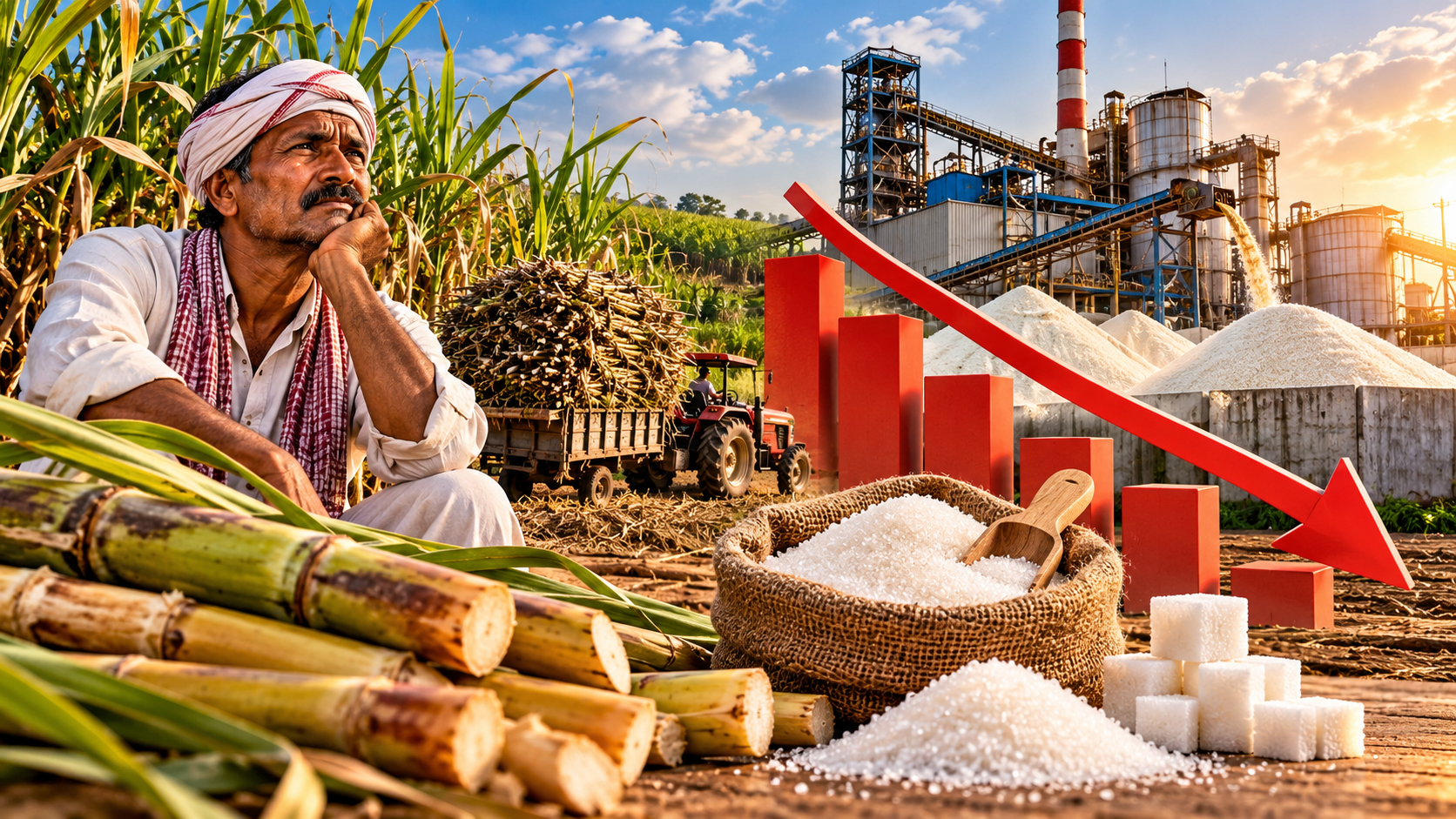
India’s net sugar production is likely to decline due to lower opening stocks and reduced output in Maharashtra and Karnataka, while the government is expected to restrict sugar diversion for ethanol production.
Highlights
- India’s net sugar production may fall to 28 million tonnes in 2026-27.
- Output could decline from 31 million tonnes in the previous season.
- Around 3 million tonnes of sugar was diverted for ethanol production last season.
- ISMA projects sugar consumption at 28.5–29 million tonnes in 2026-27.
- Opening sugar stocks have dropped to 3.5–3.6 million tonnes, the lowest in over a decade.
India’s Sugar Production May Fall to 28 Million Tonnes in 2026-27, Lowest in a Decade
India’s sugar industry is facing a challenging season as net sugar production for 2026-27 is expected to decline to around 28 million tonnes (MT), compared with 31 MT in the previous season.
The decline is mainly attributed to lower sugarcane production in key growing states, particularly Maharashtra and Karnataka, along with reduced opening stocks.
According to a Financial Express report dated October 16, industry sources expect sugar availability to remain tight during the new marketing season, raising concerns about domestic supply and ethanol production.
Sugar Production Expected to Decline
India’s net sugar production is projected to fall to approximately 28 MT in the 2026-27 season, which runs from October to September.
The previous season recorded gross sugar production of around 31 MT, of which approximately 3 MT was diverted for ethanol manufacturing.
Deepak Ballani, Director General of the Indian Sugar & Bio-energy Manufacturers Association (ISMA), said the industry does not expect to divert a similar quantity of sugar for ethanol this season.
He indicated that both gross and net sugar production could remain close to 28 MT.
Maharashtra and Karnataka Crops Under Pressure
The sugarcane crop in Maharashtra, particularly the Marathwada region, and Karnataka has been affected by adverse weather conditions.
ISMA has estimated sugar consumption during 2026-27 at approximately 28.5–29 MT.
However, the actual impact of weather-related crop damage will become clearer once harvesting begins.
The association is expected to conduct another assessment after 10–15 days to evaluate production prospects.
Government May Restrict Ethanol Diversion
The government is expected to introduce measures to prevent excessive diversion of sugarcane and sugar for ethanol production.
For the 2026-27 ethanol supply year, which runs from November to October, authorities are likely to prioritise adequate domestic sugar availability.
In August, the government permitted the use of 1 MT of raw sugar imported from Brazil to supplement ethanol production.
However, high international sugar prices compared with domestic prices have made imports less attractive.
Sugar Stocks Fall to Decade Low
India’s opening sugar stocks at the beginning of the 2026-27 season have declined to approximately 3.5–3.6 MT, their lowest level in more than a decade.
The reduction reflects lower production in the previous season and tighter availability in the domestic market.
Industry representatives expect sugar prices to stabilise gradually, although additional imports of sweetener may eventually be required.
Retail Sugar Prices Rise
Sugar prices have already shown an upward trend in the domestic market.
According to data cited from the Department of Consumer Affairs, the average retail sugar price stood at ₹57.82 per kg on Friday, reflecting a 2.4% year-on-year increase.
However, prices declined by approximately 2% month-on-month.
The combination of lower production, reduced opening stocks and steady domestic demand could keep the sugar market under pressure during the 2026-27 season.