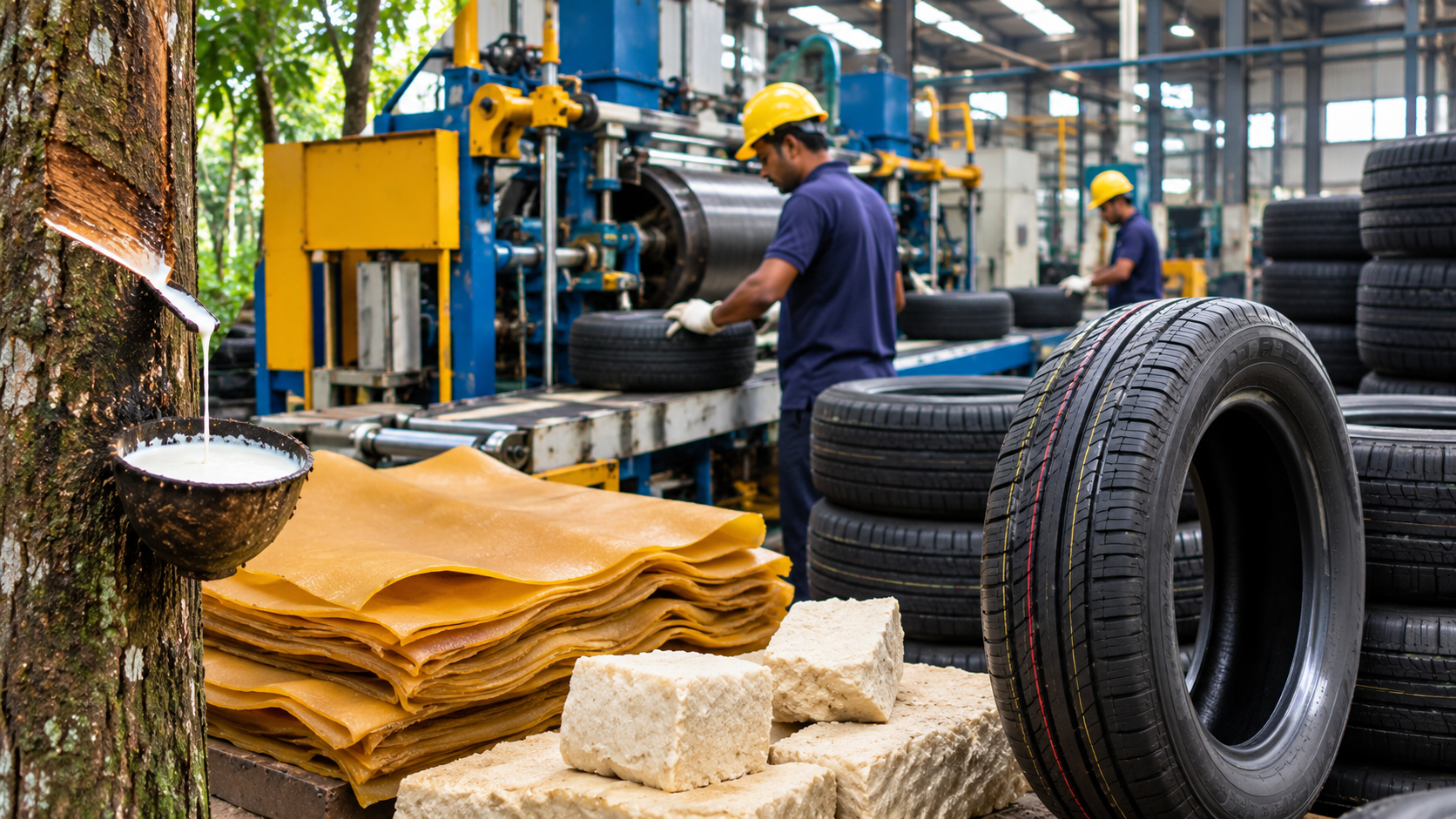
The Automotive Tyre Manufacturers’ Association has sought temporary duty-free imports of natural rubber under a quota system, citing a 37% domestic supply deficit. Natural rubber prices have surged nearly 62% from the November 2025 average to around ₹300 per kg.
New Delhi, November 6 — The Automotive Tyre Manufacturers’ Association (ATMA) has urged the government to temporarily allow duty-free imports of natural rubber as domestic tyre manufacturers grapple with a sharp increase in prices and a significant supply shortage.
In a letter to Commerce and Industry Minister Piyush Goyal, ATMA sought permission to import natural rubber under a Tariff Rate Quota (TRQ) system, limited to the assessed gap between domestic demand and supply until market conditions normalise.
Natural rubber prices jump 62%
According to ATMA, domestic natural rubber prices have reached around ₹300 per kg, representing an increase of nearly 62% from the November 2025 average of ₹186 per kg.
The tyre industry body said supplies remain inadequate despite the industry currently being in the peak rubber tapping season.
India produced 9.05 lakh tonnes of natural rubber in FY26, compared with consumption of 14.27 lakh tonnes.
This resulted in a supply shortage of around 5.22 lakh tonnes, equivalent to nearly 37% of domestic consumption.
ATMA Chairman Arun Mammen said tyre manufacturers depend on the peak tapping season to secure domestic rubber for their production requirements, but supplies have fallen short this year while procurement costs have increased substantially.
He said a temporary duty-free quota restricted to the actual supply deficit would help manufacturers maintain production while protecting domestic rubber growers.
Current import duty at 25%
Natural rubber imports currently attract a Basic Customs Duty (BCD) of 25% or ₹30 per kg, whichever is lower.
Finished tyres, meanwhile, attract a customs duty of 10%, which increases to 15% for certain categories, including truck and bus radial tyres and passenger car radial tyres.
Tyre manufacturers are also facing higher costs for other raw materials, including synthetic rubber, carbon black and petroleum-based inputs.
ATMA said the West Asia crisis has further increased crude oil prices as well as freight and logistics costs.
India’s tyre industry has an annual turnover of approximately ₹1 lakh crore, while exports exceed ₹27,000 crore.
Tyre exports increased 16% year-on-year during the first quarter of FY27.
ATMA said access to natural rubber at competitive prices is critical for maintaining domestic manufacturing, ensuring uninterrupted production and protecting India’s competitiveness in export markets.