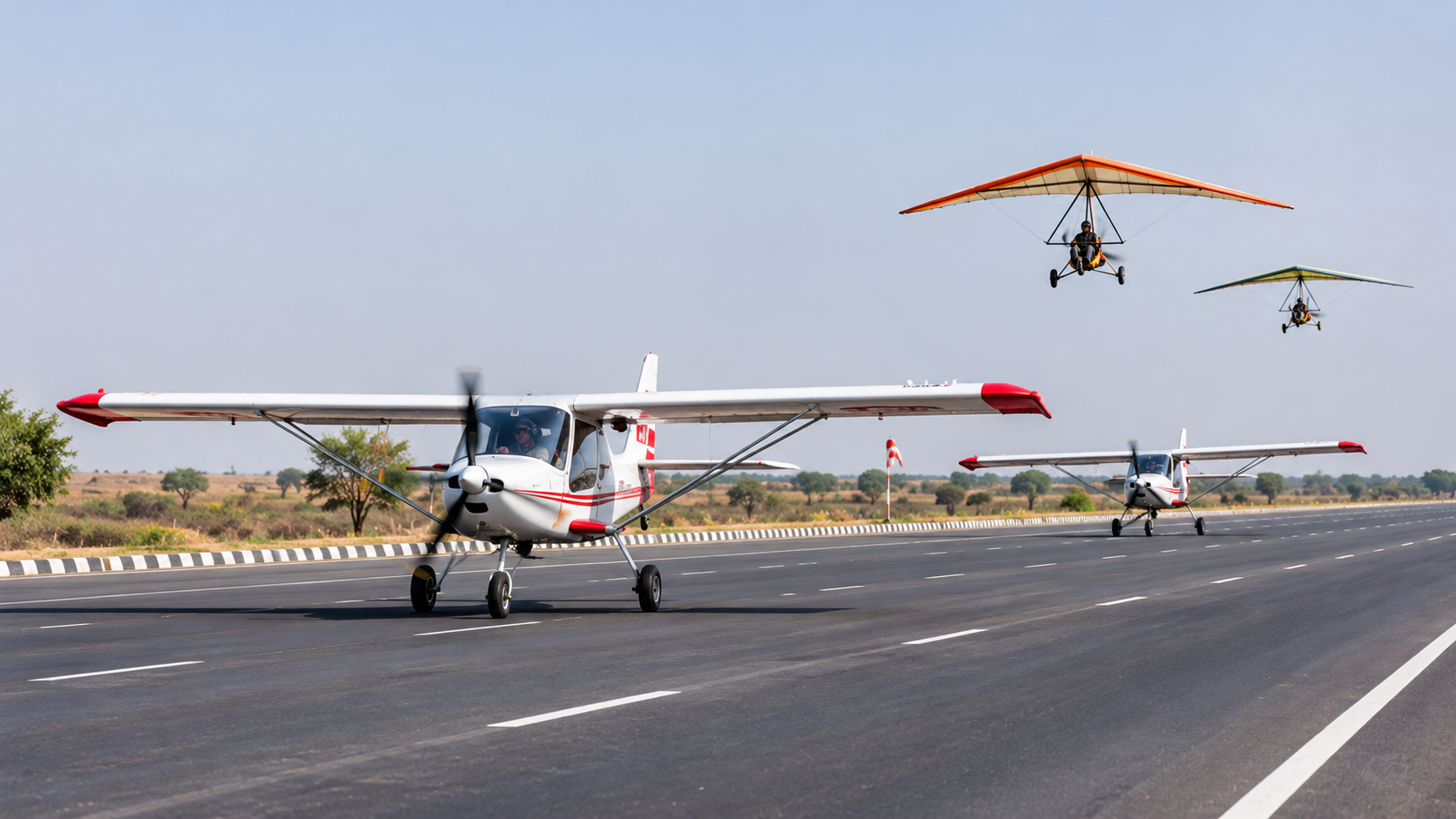
The demonstration on the Amritsar-Jamnagar Economic Corridor highlighted the potential of high-quality national highways for specialised strategic and operational applications.
Four aircraft belonging to the Indian Army landed on the Amritsar-Jamnagar Economic Corridor (NH-754A) in Patan, Gujarat, on November 24, demonstrating the potential of national highways for specialised strategic applications.
According to an official statement, the aircraft were operated by the Army’s Team Mountain Eagles. The landing was part of the Wings of Valour and Unity Expedition 2026, organised by the Army Adventure Nodal Centre (AANC) of the Military College of Telecommunication Engineering (MCTE), Mhow, Madhya Pradesh.
Two Microlight Aircraft and Two Powered Hang Gliders
The demonstration involved four aircraft, comprising two fixed-wing microlight aircraft and two powered hang gliders.
The aircraft had taken off from Kandla Airport before landing on the designated stretch of the economic corridor in Gujarat.
The exercise showcased how appropriately designed highway infrastructure could potentially support activities beyond conventional road transportation, subject to technical and operational requirements.
Highway Engineering Capabilities Highlighted
The concerned highway stretch has been designed to handle a traffic loading capacity of 170 million standard axles. Its pavement includes a 550 mm pavement crust and a 500 mm subgrade.
These engineering specifications were highlighted in the official statement as part of the demonstration’s focus on the infrastructure capabilities of the corridor.
Gadkari Congratulates Army and NHAI
Union Road Transport and Highways Minister Nitin Gadkari congratulated the Indian Army’s Team Mountain Eagles, the National Highways Authority of India (NHAI) and other authorities involved in carrying out the demonstration.
The statement highlighted the potential of suitable highway stretches for specialised applications, subject to technical assessment, operational requirements and the necessary safety clearances.
The exercise brought attention to the broader strategic utility of national highway infrastructure alongside its primary role in supporting road connectivity and transportation.