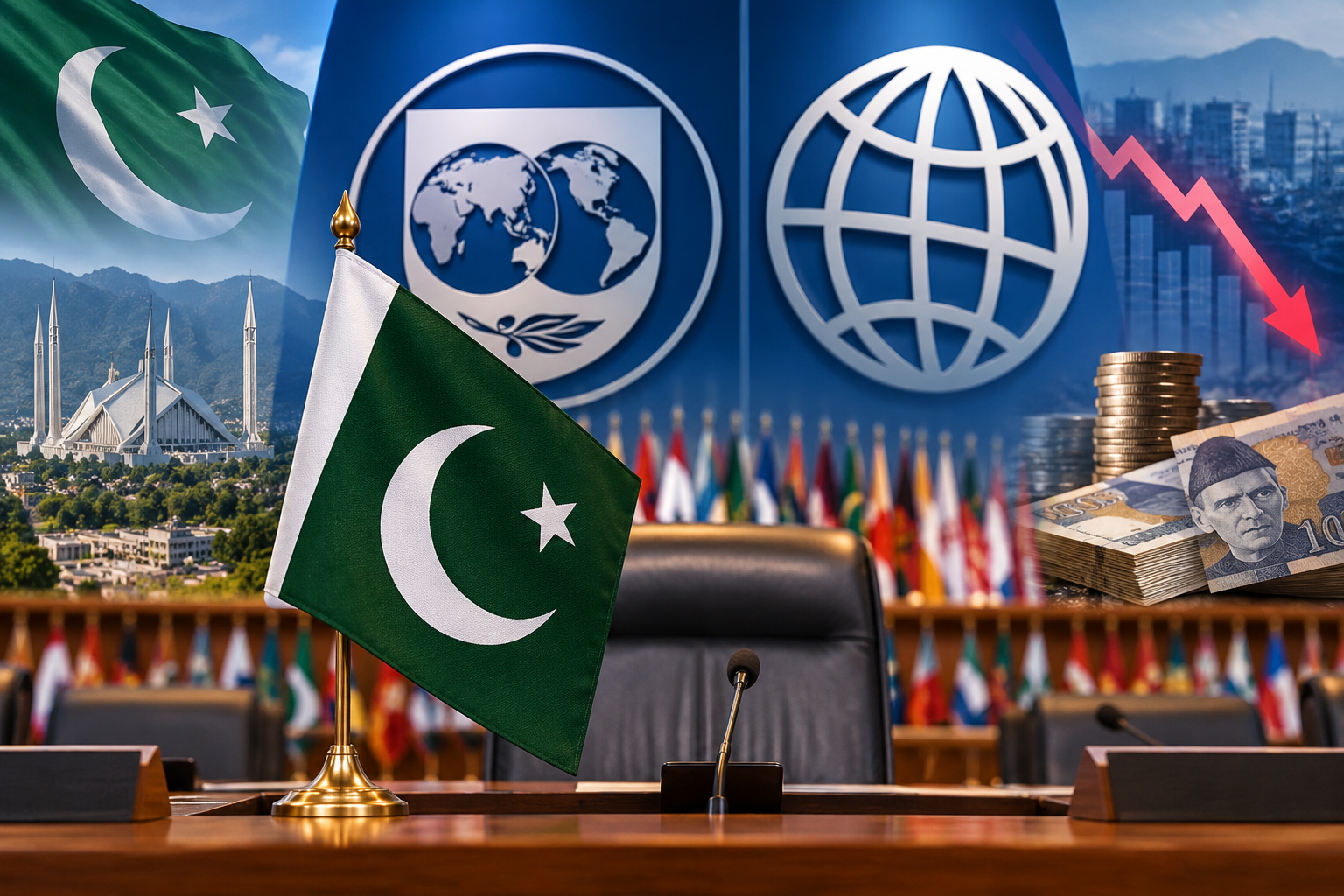
Pakistan has described its selection to chair the IMF and World Bank Boards of Governors in 2027 as a historic achievement, even as the country continues to face economic challenges and depends on external financial support.
Highlights
- Pakistan selected to chair IMF and World Bank Boards of Governors in 2027.
- Pakistani government calls the appointment a historic diplomatic milestone.
- Islamabad expects a greater role in international economic discussions.
- The position will help Pakistan facilitate dialogue among member countries.
Pakistan Returns to Global Financial Leadership After 74 Years
New Delhi, October 17: Pakistan, which continues to depend on international financial assistance, has been selected to chair the Boards of Governors of the International Monetary Fund (IMF) and World Bank Group in 2027. The appointment marks the country’s return to the position for the first time since 1953.
Pakistan’s Minister for Economic Affairs, Ahad Khan Cheema, was formally announced as the incoming chair during the IMF-World Bank Annual Meetings held in Bangkok, Thailand, on October 16.
The Pakistani Ministry of Economic Affairs described the development as a historic milestone. It said the chairmanship would provide Islamabad with an opportunity to participate in global economic and development discussions and encourage cooperation among member countries.
Pakistan Still Depends on IMF Loans
The appointment comes at a time when Pakistan continues to face serious financial challenges, including debt repayments, inflation and pressure on foreign exchange reserves.
Pakistan is currently receiving financial support under a $7 billion Extended Fund Facility (EFF) from the IMF. The country also has access to a $1.4 billion Resilience and Sustainability Facility (RSF), designed to address climate-related economic risks.
According to reports, Pakistan is awaiting approval for another $1.2 billion in IMF financing. The country has entered into at least 25 IMF loan programmes since joining the institution in 1950.
What Will Pakistan’s New Role Mean?
As chair, Pakistan will preside over meetings involving finance ministers, central bank governors and senior economic policymakers from IMF and World Bank member countries.
However, the chairmanship is primarily a procedural and diplomatic responsibility. It does not provide Pakistan with additional voting rights, control over IMF lending decisions or preferential access to financial assistance.
The position will nevertheless give Islamabad a prominent platform to participate in discussions on international financial stability, economic development and challenges facing developing nations.
Economic Challenges Remain
Despite securing the international position, Pakistan faces the difficult task of improving its financial stability and reducing dependence on foreign loans.
The government is pursuing economic reforms, including efforts to increase tax revenue, attract investment and privatise state-owned enterprises. Finance Minister Muhammad Aurangzeb recently said Pakistan expects economic growth of more than 4% during the current fiscal year.
Pakistan will chair the 2027 IMF-World Bank Annual Meetings, scheduled to take place in Washington, DC, from October 4 to 9. The appointment offers diplomatic recognition, but the country’s long-term economic recovery will depend on its financial policies and implementation of reforms.