
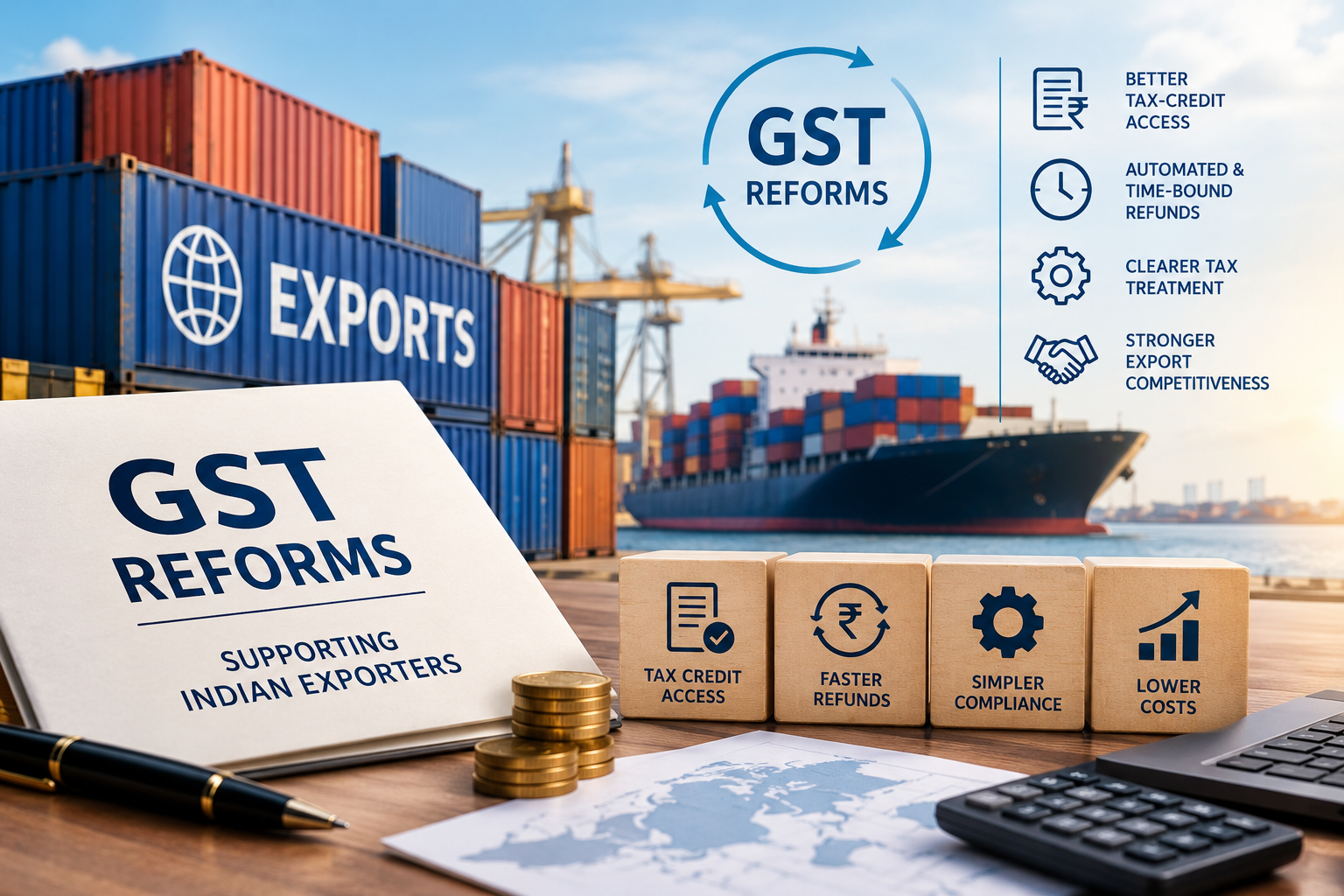
GST Reform Could Cut Costs
The GST Council is examining a series of measures that could improve tax-credit and refund mechanisms for exporters and lower the cost of doing business in India’s export sector.
The proposals come amid growing concerns among exporters over the treatment of taxes and refunds under the GST framework. Industry representatives have argued that greater clarity and faster refunds are essential for maintaining the competitiveness of Indian exporters.
One area under consideration is the treatment of goods belonging to foreign customers when work such as repair, testing, certification, storage or processing is carried out in India. The proposed approach could allow such transactions to qualify as exports even when the goods remain in India.
This could be particularly relevant for specialised manufacturing and services where foreign-owned goods are temporarily brought into India for processing or other activities before being returned to customers.
The Council is also considering changes concerning supplies made to foreign buyers where goods are delivered within India. Under certain circumstances, such transactions could receive export-equivalent treatment when payment is received in foreign exchange or in rupees through mechanisms permitted by the Reserve Bank of India.
Another important area is the treatment of tax paid on plant and machinery used by exporters. Proposed changes could widen eligibility for tax benefits and improve working-capital efficiency for export-oriented companies.
The proposals also seek to simplify refund procedures. Claims could be acknowledged within a specified period, with deemed acceptance if the prescribed timeline expires without action. A significant portion of eligible refunds could potentially be released after a risk-based verification process.
Electronic matching of export invoices with bank realisations could further reduce manual intervention and accelerate refund processing.
The changes are aimed at making India’s GST framework more supportive of exporters by reducing blocked working capital, improving certainty around tax treatment and lowering administrative costs.
For businesses competing in global markets, faster tax refunds and predictable compliance could provide a meaningful improvement in cost competitiveness.