

Mumbai Developer Targets Expansion Key Highlights Mumbai-focused real estate developer Pranav Constructions has fixed a price band of Rs 118 to Rs 124 per share for its initial public offering, with the issue expected to raise more than Rs 351 crore. The company announced that the IPO will open for public subscription on September 7 and close on September 9. The issue consists of a fresh equity share issuance of approximately Rs 315.6 crore and an offer for sale of 28.57 lakh equity shares by investor shareholder BioUrja India Infra. The total issue size is expected to be around Rs 351 crore. According to the company’s red herring prospectus, funds raised through the fresh issue will be used for several purposes linked to its redevelopment business. These include obtaining government and statutory approvals, purchasing additional Floor Space Index and compensating members for alternate accommodation. The company also plans to use a portion of the proceeds to meet hardship compensation requirements for selected under-construction and upcoming redevelopment projects. Other proposed uses include debt repayment, acquisition of future redevelopment projects and general corporate expenses. Pranav Constructions operates primarily in the Municipal Corporation of Greater Mumbai redevelopment segment, particularly across Mumbai’s Western suburbs. The company focuses on redevelopment projects covering economical, mid and mass-market and aspirational housing segments. Mumbai’s redevelopment market has become an increasingly important component of the city’s real estate supply. Ageing residential buildings, limited availability of land and strong housing demand have encouraged housing societies and developers to pursue redevelopment projects. However, redevelopment projects also involve complex approval procedures, construction requirements, financing needs and negotiations with existing occupants. Efficient execution and timely receipt of regulatory approvals will therefore remain important factors for Pranav Constructions as it expands its project pipeline. The company’s proposed use of IPO proceeds indicates an emphasis on strengthening its development pipeline while managing financial requirements. Debt repayment could also help improve the company’s financial position and provide greater flexibility for future projects. The IPO comes amid continued activity in India’s primary capital market, where real estate companies are increasingly turning to public markets to raise capital and provide liquidity to existing investors. Centrum Capital and PNB Investment Services have been appointed as book-running lead managers for the issue. The company’s shares are proposed to be listed on both the BSE and NSE. For prospective investors, the company’s concentration in Mumbai redevelopment provides exposure to one of India’s most valuable and supply-constrained property markets. At the same time, the performance of the business will depend heavily on project execution, cost management, regulatory approvals and the ability to secure new redevelopment opportunities. The IPO will therefore provide investors with an opportunity to assess the company’s development pipeline and financial strategy as it prepares to enter the listed market.

India’s E-Commerce Market To Reach $345 Billion
Quick commerce drives next growth Key Highlights New Delhi, September 2 — India’s e-commerce sector is projected to nearly triple to USD 345 billion by 2030 from USD 125 billion in 2024, driven by the rapid expansion of quick commerce and increasing integration of artificial intelligence (AI), according to a report released on Wednesday. Research consultancy Infisum, in its report titled ‘Smart Growth in a Fast Market’, expects the market to grow at a compound annual growth rate (CAGR) of 18.4 per cent through 2030. Quick commerce has emerged as the fastest-growing segment of India’s e-commerce ecosystem. The segment is estimated to reach USD 65–70 billion by 2030 and is expected to contribute 45–50 per cent of incremental e-retail growth over the next five years. The expansion of rapid-delivery services is also expected to drive a sharp increase in dark-store infrastructure. The country’s dark-store network is projected to nearly triple from 2,525 locations in 2025 to approximately 7,500 by 2030. Blinkit currently leads the competitive quick-commerce market with a 44 per cent share and processed 900 million orders in FY26. Zepto follows with a 25 per cent market share, while Swiggy Instamart holds 20 per cent. Consumer demographics are also expected to play a major role in the sector’s expansion. Gen Z already accounts for nearly one-third of online shoppers and is expected to become India’s largest digital spending cohort by 2030. The growth of online commerce is increasingly extending beyond metropolitan centres. Around 66 per cent of new direct-to-consumer (D2C) orders now originate from Tier II and Tier III cities, highlighting the increasing importance of smaller markets. By the end of the decade, e-commerce is expected to account for 10–12 per cent of India’s total retail spending and contribute 2.5 per cent to national GDP. The sector is projected to serve around 420–440 million online shoppers. Technology is expected to remain a major driver of this transformation. AI and machine learning are projected to improve retail productivity by 35–37 per cent by 2030. Technologies including conversational commerce, AI-powered shopping assistants and virtual try-ons are changing consumer discovery and purchasing behaviour. The report indicates that quick-commerce expansion, growing digital adoption in smaller cities and AI-led retail innovation will remain central to India’s e-commerce growth over the coming years.

FCNR(B) Inflows Cross $100 Billion
RBI swap window draws strong inflows Key Highlights New Delhi, September 2, 2026 — Capital inflows through Foreign Currency Non-Resident (Bank), or FCNR(B), deposits crossed the $100-billion mark by August 31, substantially exceeding the Reserve Bank of India’s earlier expectations for the special foreign-exchange swap programme. According to a Financial Times report cited by Business Standard, the FCNR(B) scheme accounted for the bulk of the inflows under the RBI’s special swap facility. The facility also attracted funds through external commercial borrowings (ECBs) and overseas foreign currency borrowings (OFCBs). (Business Standard) The RBI had earlier estimated that the three routes together could attract around $80 billion. Governor Sanjay Malhotra had said in August that the central bank expected inflows of at least $80 billion through the subsidised swap facilities, describing the strong response as a reflection of India’s macroeconomic fundamentals and a potential boost to the country’s balance of payments. (Reuters) The central bank operationalised the special swap facility on June 8, while FCNR(B) inflows began on June 23. RBI data available up to August 21 showed that the three routes had already attracted $72.85 billion, including $65.4 billion through FCNR(B) deposits, $4.86 billion through OFCBs and $2.59 billion through ECBs. (Business Standard) The strong response prompted the RBI to bring forward the closure of the FCNR(B) window. The facility, originally scheduled to remain available until September 30, closed on August 31. However, banks can continue to use the RBI’s swap facility for FCNR(B) deposits that had already been contracted until September 11. The swap arrangements carry maturities of three to five years, with most of the funds raised under the facility coming through deposits with a five-year maturity. The ECB and OFCB windows, meanwhile, will remain open until December 31, 2026. (Business Standard) The surge in foreign-currency deposits has strengthened the RBI’s foreign-exchange position at a time when the central bank has been actively managing pressure on the rupee. Reuters reported that NRI deposits under the concessional swap arrangements rose from $65.4 billion on August 21 to more than $100 billion by August 31, adding to the central bank’s capacity to support the currency and intervene in foreign-exchange markets. (Reuters) The RBI’s decision to close the FCNR(B) window early was earlier described by Malhotra as a calibrated and data-driven response to the strong inflow response. The central bank had indicated that advancing the deadline was a decision taken from a position of strength. (Reuters) The scale of the inflows provides India with an additional foreign-exchange buffer and comes as the RBI continues to navigate external pressures including elevated oil prices, global bond yields and volatility in currency markets. The strong mobilisation also highlights the response from overseas depositors to the temporary incentives built into the special swap facility. With the FCNR(B) window now closed but contracted transactions eligible for swaps until September 11, attention will shift to the remaining ECB and OFCB facilities and the extent to which the additional foreign-currency inflows strengthen India’s external-sector resilience.

US Completes Fresh Strikes On Iran
U.S. forces completed a new wave of offensive military strikes against multiple sites in Iran, marking a renewed escalation following recent disruptions to commercial shipping in the Strait of Hormuz and threats to regional security.

Coal India Output Drops 6% In August
Demand and e-auction premiums strengthen Key Highlights New Delhi, September 2, 2026 — Coal India Ltd.’s production fell 6% year-on-year in August 2026, but stronger coal offtake, rising e-auction premiums and declining inventories have kept brokerages positive on the state-run miner. Coal supplies to the power sector increased 4% YoY to 48.5 million tonnes in August, supported by a 13% year-on-year rise in power demand in India, according to UBS. Supplies to the non-regulated sector also grew 10% YoY to 12.1 million tonnes. The company’s e-auction realisations provided another positive signal. Coal India sold coal at an average premium of 59% over the notified price in August, according to provisional data, compared with an average premium of 46% during the first five months of the current fiscal year. UBS, however, flagged a 6% YoY decline in Coal India’s production in August and a 5% decline during the first five months of fiscal 2027. Despite the lower output, the brokerage maintained its Buy rating on the stock with a target price of Rs 550. HSBC also highlighted stronger volumes in August, noting that dispatch growth had finally improved after two years of weakness. It retained a Hold rating on Coal India with a target price of Rs 440. The brokerage expects offtake to remain strong in the near term, citing robust power demand, low coal inventories and higher thermal generation. It also expects e-auction premiums to remain elevated as inventories at pitheads and power plants have fallen to three-year lows, while regional coal prices have risen. HSBC expects e-auction prices to strengthen further as industrial activity and power demand enter a seasonally stronger period following the festivals. Morgan Stanley similarly expects e-auction premiums to remain elevated, supported by higher global thermal coal prices. It maintained an Equal-weight rating on Coal India with a target price of Rs 420. Nuvama has upgraded Coal India to Hold from its earlier stance and raised its target price to Rs 454 from Rs 396. The brokerage expects volumes to recover as power generation increases and coal imports remain subdued. Nuvama also raised its FY27E and FY28E EBITDA estimates by 13% and 8%, respectively. However, it expects higher employee costs arising from wage revisions to weigh on profitability from FY28. Beyond the near-term coal cycle, Nuvama identified gasification, power and critical minerals as long-term opportunities for Coal India, although the benefits from these areas are expected to emerge over the next four to five years. The combination of stronger offtake, depleted inventories and elevated e-auction premiums is therefore providing support to Coal India’s near-term outlook despite the decline in production. Brokerages are watching the recovery in volumes and realisations closely as power demand and industrial activity strengthen.

UPI Transactions Hit Record High
UPI reaches a record 24.51 billion transactions in August 2026, highlighting India’s continued growth in digital payments and financial technology.
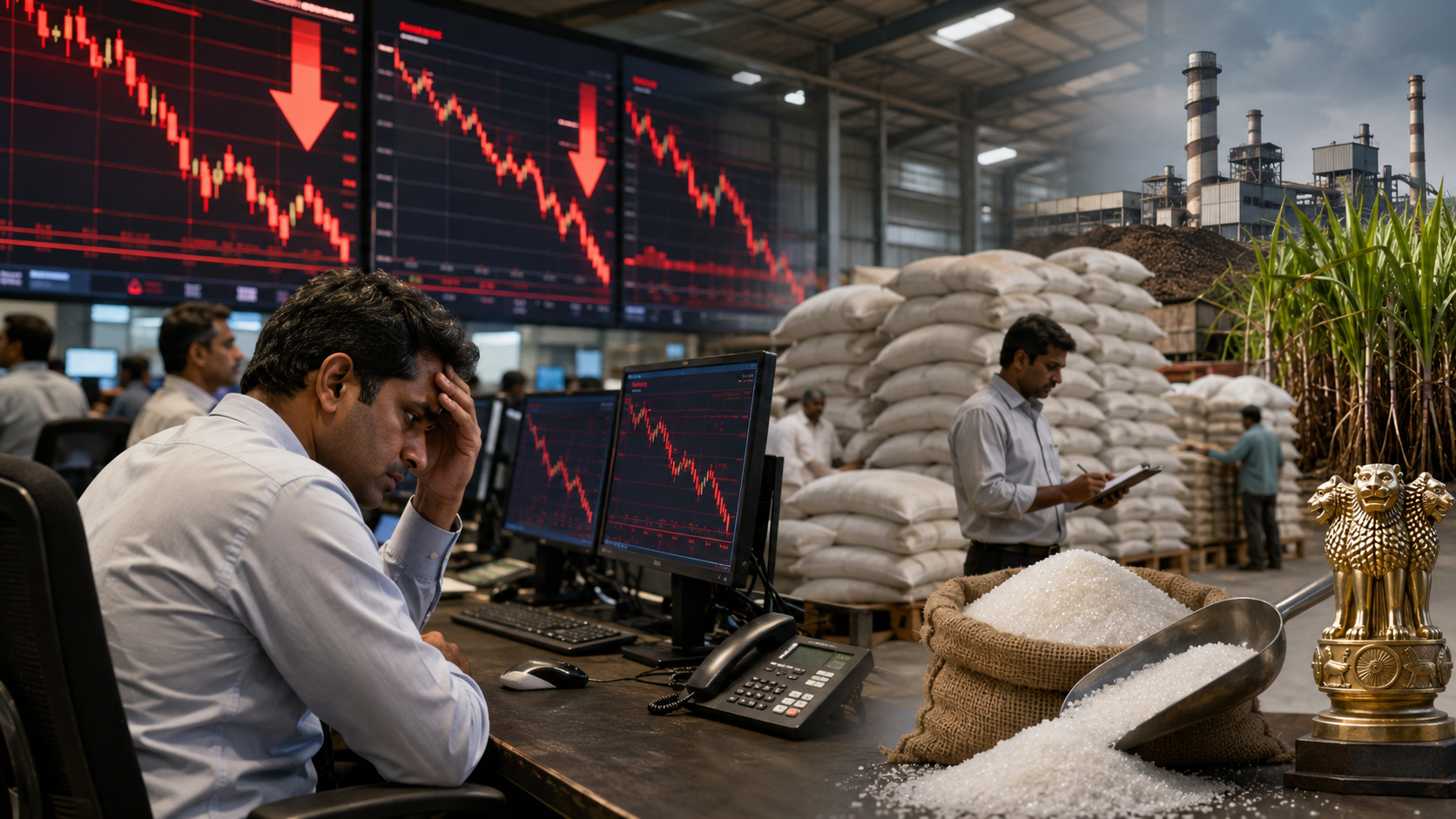
Sugar Stocks Slide After Stock Limit Cut
Sugar stocks falling sharply in the Indian stock market following the government’s decision to halve the stockholding limit for sugar dealers.

GST Collection Nears ₹2 Lakh Crore
India’s GST collections approaching the ₹2 lakh crore milestone in August 2026, highlighting strong tax revenue growth and resilient economic activity.

Parle Biscuits Names George Kovoor CEO
George Kovoor taking charge as CEO of Parle Biscuits, representing a major leadership transition in India’s FMCG and biscuit industry.

Parle Biscuits Appoints George Kovoor
A corporate FMCG leadership announcement representing Parle Biscuits and its new CEO.
