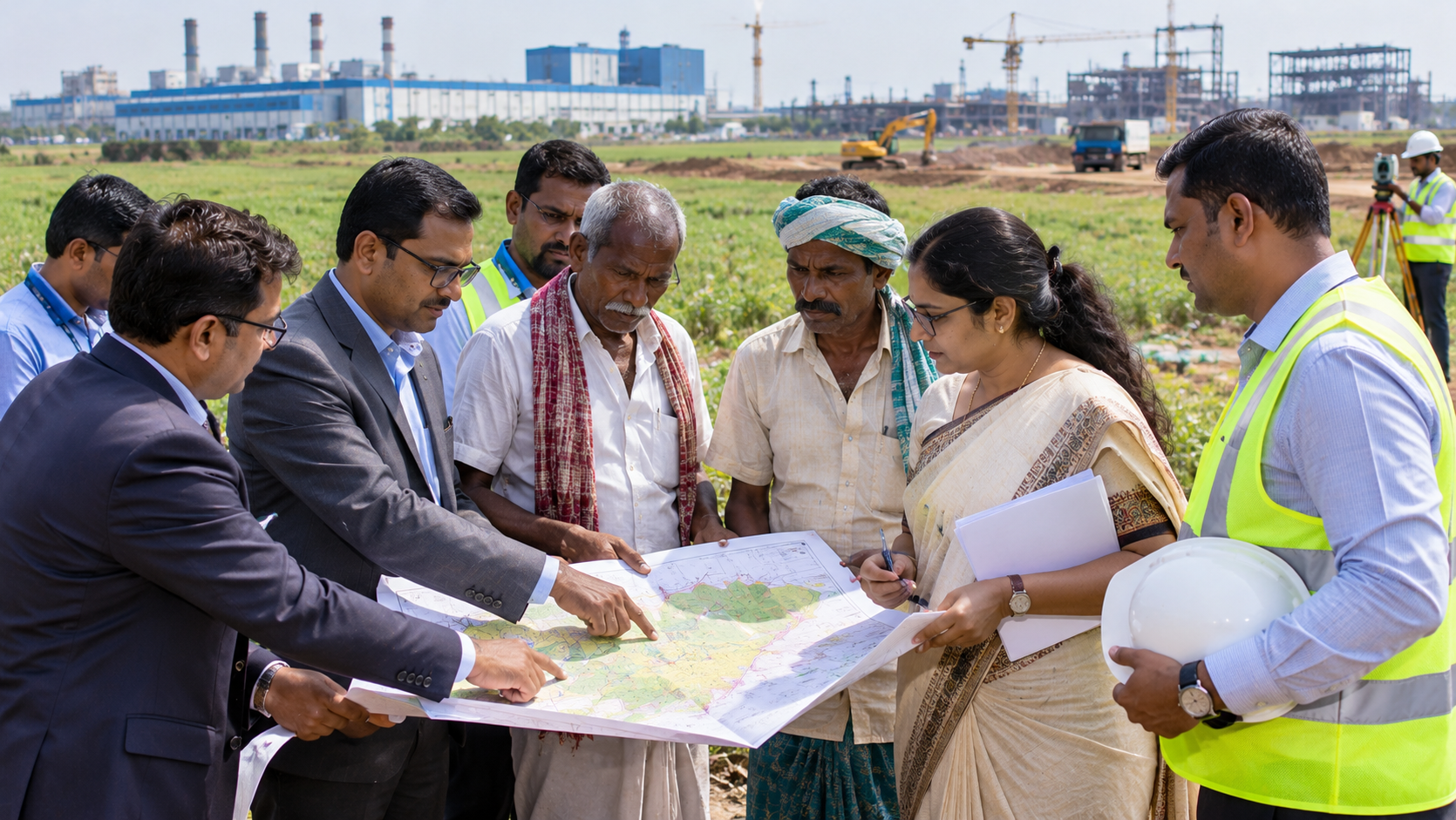
West Bengal’s new investment promotion policy seeks to encourage industries to acquire land directly from owners by offering easier eligibility for strategic and mega project status. Companies purchasing 500 acres independently can qualify, while projects using government-allotted land will need at least 1,000 acres.
Kolkata, November 6 — The West Bengal government has introduced a new investment promotion policy aimed at encouraging industries to acquire land directly from landowners while making large industrial projects easier to establish in the state.
Under the new policy, investors that independently acquire 500 acres of land can qualify for “strategic and mega project” status, making them eligible for incentives.
In comparison, projects relying on land allotted by government agencies will have to meet a higher threshold of 1,000 acres to qualify for the same status.
No forcible acquisition from farmers
The policy comes against the backdrop of West Bengal’s long-standing shortage of industrial land and the political sensitivity associated with land acquisition.
The source notes that the Singur and Nandigram movements during the Left Front regime had triggered major protests against compulsory land acquisition for industrial projects.
Chief Minister Suvendu Adhikari said his government would not forcibly acquire farmers’ land, while also signalling that industrialists would not be left entirely on their own to arrange land.
The government is considering several options, including direct purchases from landowners, land pooling and recovery of unused industrial plots.
Under land pooling, owners could voluntarily contribute their land for planned development. Part of the pooled land could be used for infrastructure, while developed plots would be returned to owners in proportion to their contribution.
Unused industrial land could be recovered
The government is also exploring funding arrangements with HUDCO, NABARD, the Asian Development Bank and other financial institutions to finance direct purchases of land.
Another proposal would allow the state to recover unused industrial land allotted to companies.
Industrial units would be required to begin production within three years of acquiring land, and the government is considering cancelling allotments where projects fail to take off within the stipulated period.
Land utilisation would also be monitored through a GIS-enabled inventory containing information such as ownership, plot size, permitted use, connectivity and available infrastructure.
Green power provisions included
The broader policy provides tailor-made incentives for strategic and mega projects, with additional assistance potentially linked to the size of investments and commitments made by companies.
It also allows green power procurement through open access and provides for net metering.
The government’s overall land strategy is aimed at making large and contiguous land parcels available for industrial development while avoiding the social and political challenges associated with compulsory acquisition.
However, the success of direct purchases and land pooling will ultimately depend on factors such as landowners’ willingness to participate, availability of contiguous plots and compensation arrangements.