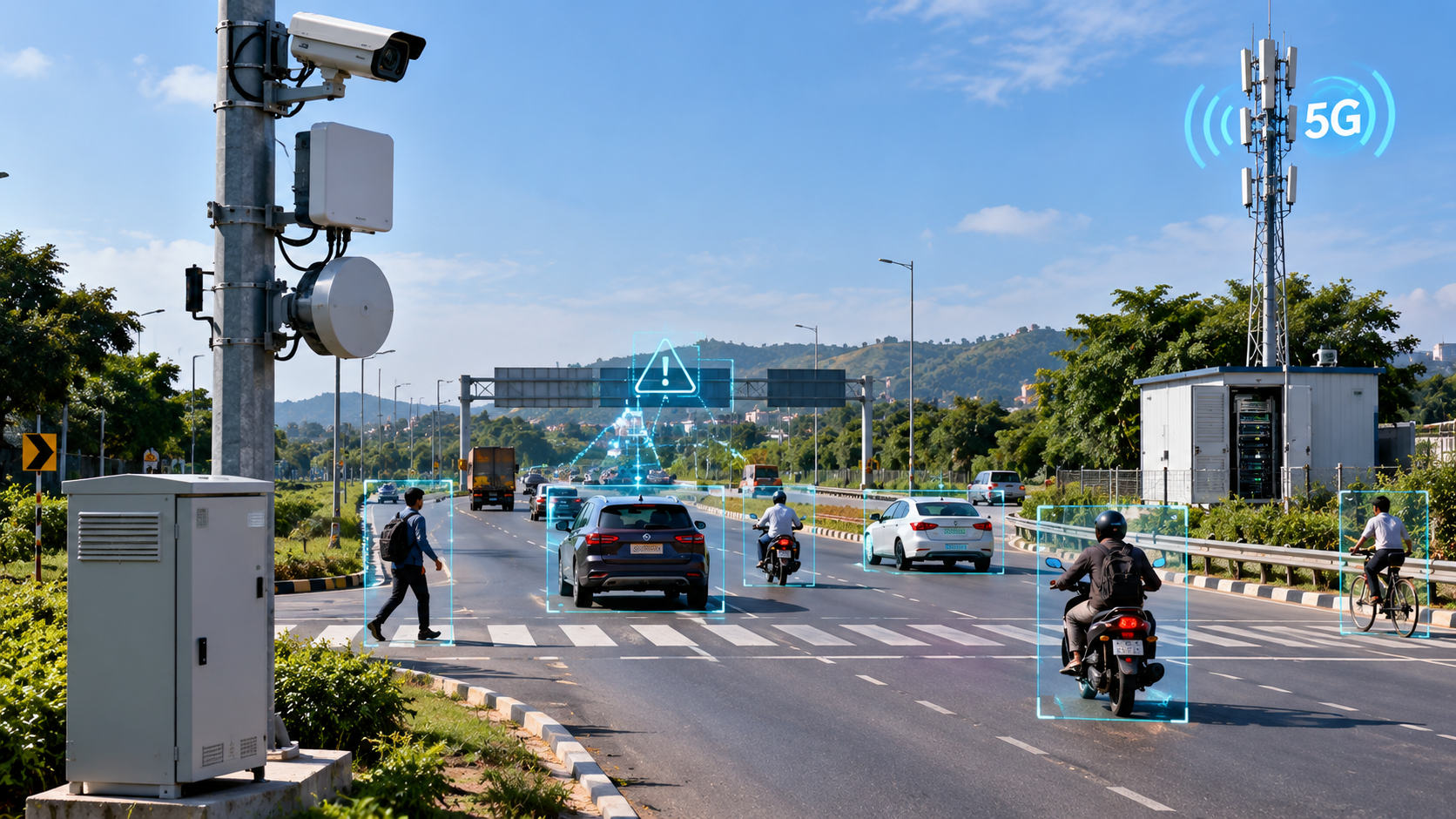
IISc-backed ARTPARK has received permission to pilot its InterSafe system on NH75, using AI, cameras, radar and 5G connectivity to detect possible collisions and send targeted warnings to road users.
Bengaluru, October 13 — The Indian Institute of Science’s AI and Robotics Technology Park, or ARTPARK, has received permission to test a 5G-powered roadside artificial intelligence system on the Bengaluru-Hassan stretch of NH75. The pilot, called InterSafe, is aimed at improving safety at highway junctions where smaller roads merge with high-speed traffic.
According to Sheela Prabhakar, head of ARTPARK’s Wired and Wireless Technologies Centre of Excellence, the project is being pursued as a proof of concept with the National Highways Authority of India. The system is designed to identify potential collision risks at unprotected junctions, where pedestrians, cyclists, two-wheelers and cars may suddenly enter or cross the highway.
InterSafe will use roadside cameras, radar and other sensors to monitor traffic conditions. AI will analyse live video and sensor data to detect possible hazards, while alerts will be delivered to drivers and smartphone users through the cellular network. ARTPARK describes this approach as an Infrastructure-to-Network-to-Person, or I2N2P, model.
A key focus of the pilot will be ensuring that warnings are selective and relevant. Prabhakar said repeated or unnecessary alerts could cause drivers to start ignoring them, reducing the effectiveness of the safety system.
The project also aims to keep roadside equipment affordable. With 5G connectivity, much of the AI processing can be moved away from the roadside hardware to nearby edge-computing infrastructure. This could allow the units installed along highways to remain lighter, cheaper and less power-intensive.
The initiative is aligned with the broader direction of highway traffic-management systems in India. NHAI’s 2023 policy includes provisions for AI-based incident detection and future use of 5G communications as network coverage expands.
If the pilot proves successful, the technology could eventually be taken forward by startups or industry partners for wider commercial deployment. ARTPARK said its role is to develop and demonstrate the technology to a stage where other players can build products and services around it.