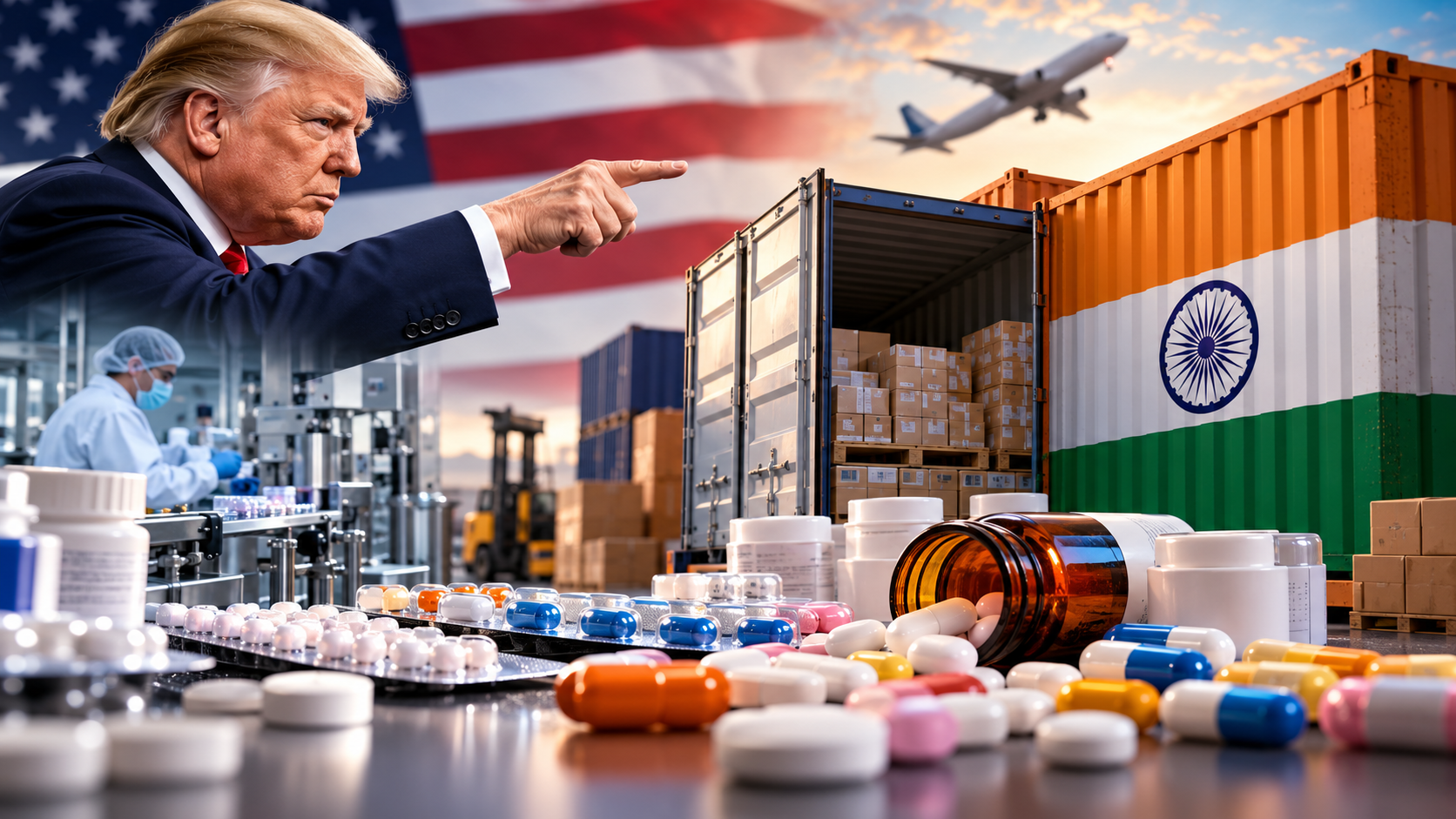
Indian pharmaceutical companies are reviewing their export strategies, delaying shipments and exploring new markets as potential US tariffs of up to 200% threaten profitability and future growth.
Highlights
- Indian pharmaceutical companies are reassessing their global expansion strategies amid US tariff uncertainty.
- Trump administration has proposed a 100% tariff on branded medicines from August 2028, followed by a possible 200% duty.
- Indian pharmaceutical exports reached $31.1 billion in FY26, compared with $30.5 billion in FY25.
- The US accounts for around 30.9% of India’s pharmaceutical exports in the first quarter of FY27.
Indian Drugmakers Redraw Global Roadmap as US Tariff Threats Cloud Growth Prospects
New Delhi, October 20: Indian pharmaceutical companies are reassessing their global business strategies as uncertainty surrounding US trade tariffs threatens exports, profitability and future expansion plans. Several drugmakers are delaying shipments, exploring alternative markets and reviewing manufacturing investments to reduce their dependence on the United States.
According to a Business Standard report, a mid-sized Mumbai-based pharmaceutical company recently postponed its first shipment of high-value nutraceutical products to the US. The company had planned to enter the American market as part of its international expansion strategy but decided to wait amid concerns over potential tariffs.
Trump’s Tariff Plans Raise Concerns
The Trump administration has proposed keeping generic medicines exempt from additional tariffs for only two years, beginning in August 2026. It also plans to introduce a 100% tariff on branded and proprietary medicines from August 2028 for one year, potentially followed by a 200% duty.
If implemented, these measures could significantly increase costs for Indian pharmaceutical exporters and squeeze profit margins in one of their largest overseas markets.
Although Indian medicines have so far escaped additional US tariffs, uncertainty over future trade policies has prompted companies to reconsider their long-term investment and export strategies.
US Remains a Major Market for Indian Pharma
India’s pharmaceutical exports increased from $30.5 billion in FY25 to $31.1 billion in FY26, according to figures presented in the report.
Exports during the first quarter of FY27 stood at $8.1 billion. Meanwhile, the US share of India’s pharmaceutical exports was approximately 30.9%, highlighting the importance of the American market for Indian drugmakers.
Several leading Indian pharmaceutical companies already operate manufacturing facilities in the United States. Sun Pharma has four plants, while Aurobindo Pharma, Dr. Reddy’s Laboratories, Lupin and Cipla have two facilities each.
Alkem Laboratories and Biocon also operate one manufacturing unit each in the US.
India additionally has around 500 US FDA-approved pharmaceutical manufacturing facilities, reflecting its strong position in the global medicine supply chain.
Companies Explore Alternative Growth Strategies
Indian drugmakers are responding to the uncertainty through cost-cutting measures, geographical diversification and adjustments to their manufacturing strategies.
The industry has already faced pricing pressure following the Trump administration’s announcements regarding substantial reductions in prescription medicine prices.
Despite these challenges, pharmaceutical companies remain confident about their international competitiveness, supported by years of manufacturing experience, regulatory approvals and established distribution networks.
Industry executives believe the US will continue to remain an important market for future expansion. However, companies are increasingly focusing on reducing risks associated with changing trade policies.
The coming years could prove crucial for India’s pharmaceutical industry as companies balance their dependence on the American market with opportunities in other international markets.