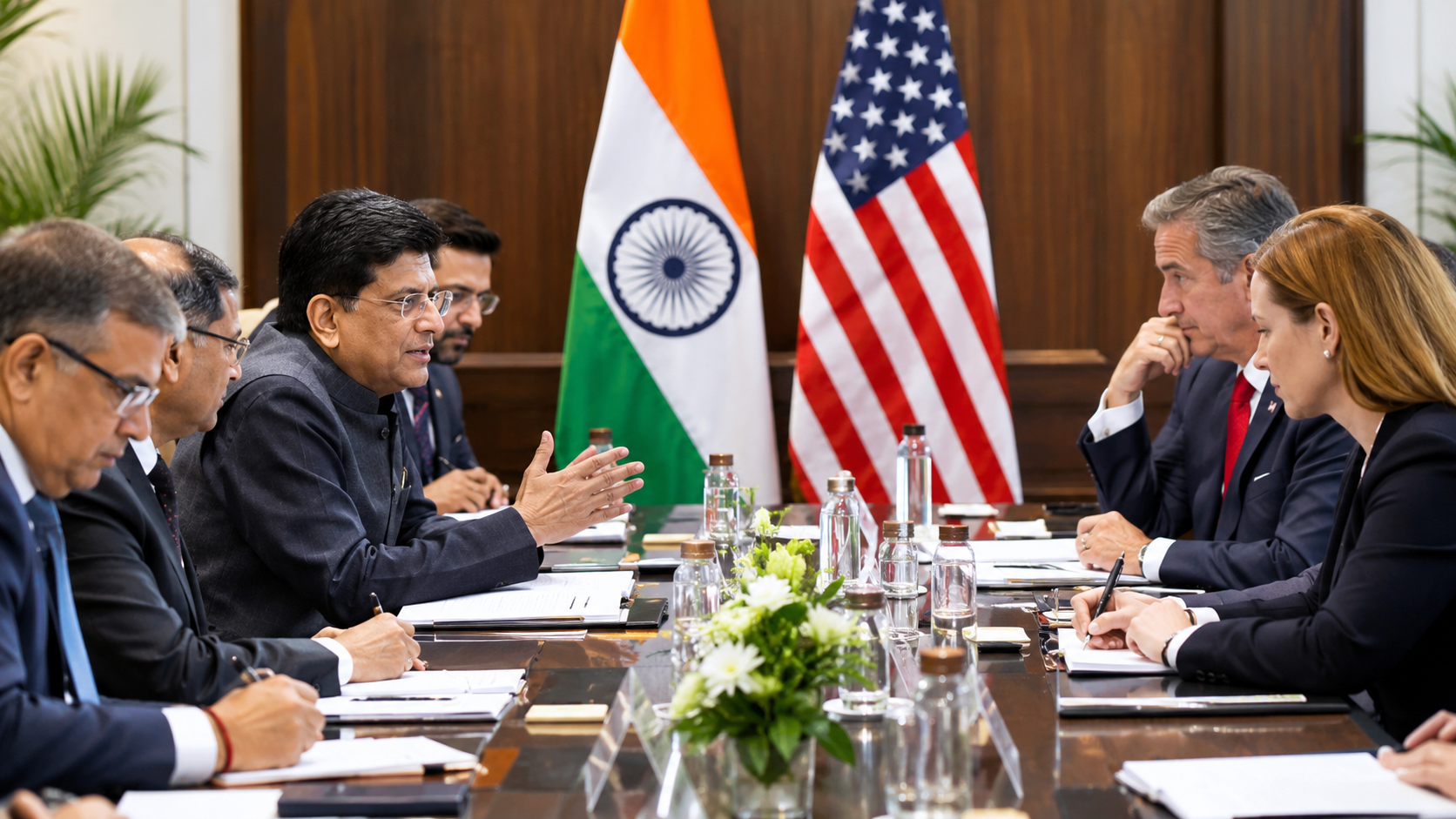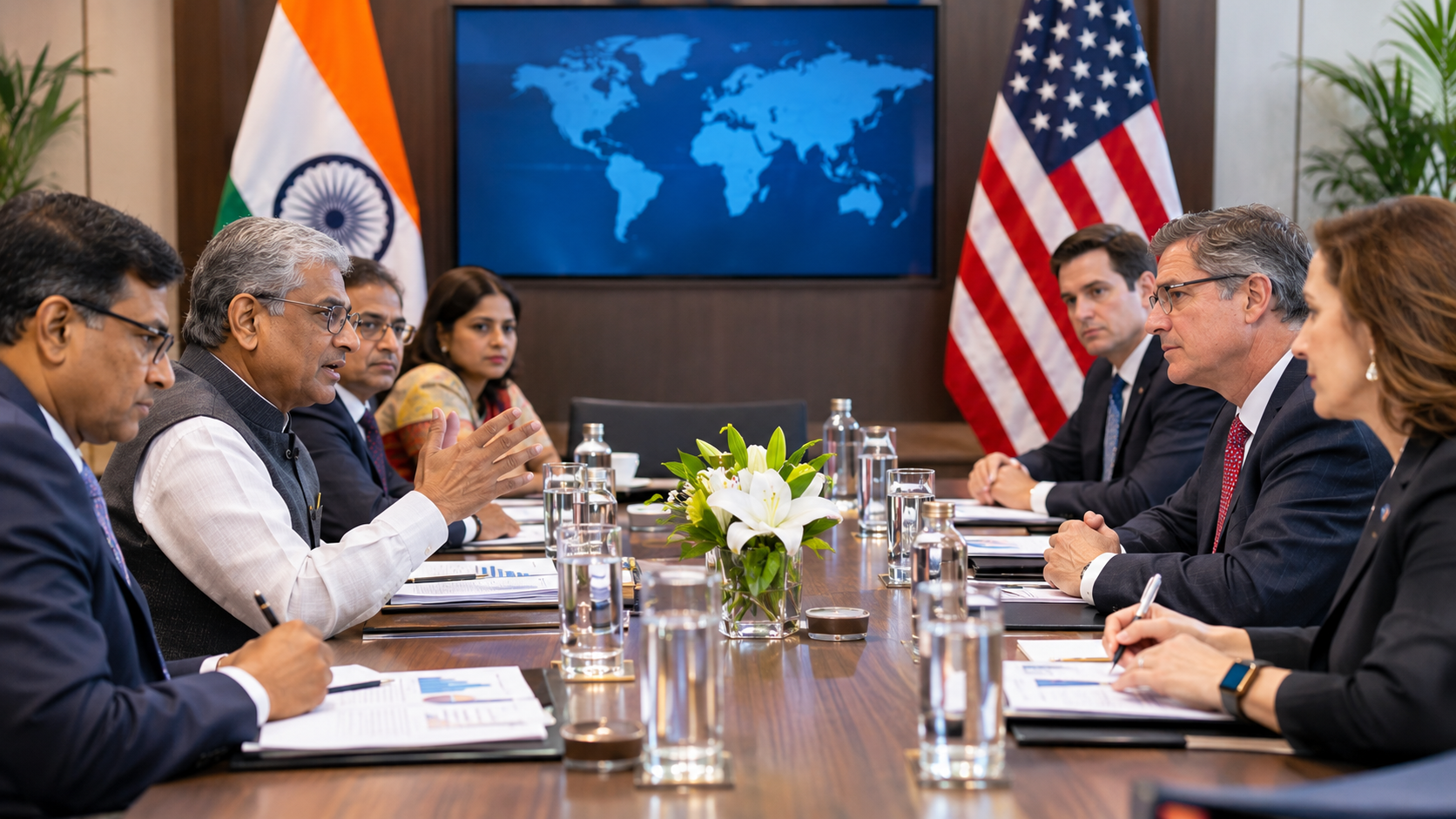
India and the United States are working towards an interim trade agreement amid changing US tariff policies, with market access and export competitiveness at the centre of negotiations.
India and the United States are working towards finalising a bilateral trade agreement (BTA), as changes in Washington’s tariff policies have brought both countries back to the negotiating table.
The two countries finalised the framework for the first phase of their trade agreement in February 2026, following negotiations that began in February 2025. However, fresh tariff proposals by the US have introduced new considerations into the discussions.
The latest developments have made tariff rates, market access and the competitiveness of Indian exports key issues in the negotiations.
Why Does India Want a Trade Agreement?
India is pursuing the trade pact to protect the competitiveness of its exports in the American market and secure better terms than competing manufacturing economies across South and Southeast Asia.
The US has been India’s largest trading partner since 2021-22. During FY26, India’s exports to the US increased 0.92% to USD 87.3 billion, while imports rose 15.95% to USD 52.9 billion.
India’s trade surplus with the US declined to USD 34.4 billion in FY26 from USD 40.89 billion in FY25.
The US is also an important export destination for Indian textiles, pharmaceuticals, engineering goods, gems and jewellery, chemicals and electronics.
Higher tariffs could make Indian products more expensive in the American market, affecting exporters’ ability to retain or expand their market share.
Why Is the US Imposing Tariffs?
The US is using tariffs to address trade deficits, protect domestic industries from foreign competition and encourage trading partners to negotiate agreements on terms favourable to Washington.
The US has alleged that countries such as India and China impose high import duties and restrictive regulations on American goods while enjoying relatively low-tariff access to the US market.
A tariff is a customs or import duty imposed by a country on goods entering its territory. It is generally paid by the importer and can increase the price of imported products.
How Has the US Tariff Structure Changed?
The tariff framework between the two countries has undergone several changes:
- August 7, 2025: The US announced a 25% duty on Indian goods.
- Additional tariff: Another 25% tariff was imposed as a penalty for India’s continued purchase of Russian oil, taking the total duty on most Indian goods to 50%, subject to exemptions.
- February 2, 2026: India and the US agreed on a trade deal under which Washington agreed to reduce the reciprocal tariff on Indian goods to 18%.
- February 20, 2026: The US Supreme Court struck down the reciprocal tariff system.
- July 24, 2026: The US imposed tariffs of 10% and 12.5% on 60 countries, including India, under Section 301, citing forced-labour-related concerns.
- November 25, 2026: The US Trade Representative announced findings from its second Section 301 investigation into structural excess manufacturing capacity in 14 economies, including India.
Following the latest investigation, the US proposed additional tariffs of up to 25% on Indian goods, while indicating that the rate could be adjusted to 17% if a trade agreement is reached.
What Are the US Allegations Against India?
The USTR has alleged that India’s industrial policies, including the Make in India initiative and Production Linked Incentive (PLI) schemes, manufacturing expansion plans, labour protections, financial practices and market access barriers contribute to structural excess capacity.
The report identified sectors such as steel, solar, pharmaceuticals, medical devices and information and communications technology as areas of concern.
India has rejected the allegations, stating that it does not have structural excess capacity in any sector. New Delhi has maintained that trade-related concerns should be addressed through negotiations under the bilateral trade agreement.
What Does the Interim Trade Framework Propose?
The joint statement issued by India and the US on February 7, 2026, outlined a framework for an interim agreement on reciprocal and mutually beneficial trade.
The proposed terms include:
- India will eliminate or reduce tariffs on all US industrial goods and a wide range of food and agricultural products.
- The US will apply an 18% reciprocal tariff rate on Indian goods, subject to the successful conclusion of the interim agreement.
- Both countries will address non-tariff barriers affecting bilateral trade.
- India intends to purchase USD 500 billion worth of US energy products, aircraft and aircraft parts, precious metals, technology products and coking coal over the next five years.
The framework also states that if either country changes the agreed tariff commitments, the other country may modify its commitments accordingly.
Has India Secured a Competitive Advantage?
India is seeking tariff rates lower than those offered to competing manufacturing countries so that Indian exporters can price their products more competitively in the US market.
Under the latest USTR proposal, India could face a 17% tariff if the trade pact is finalised.
This would provide a one-percentage-point advantage over Bangladesh, Cambodia, Indonesia, Malaysia and Thailand, where the cited deal rate is 18%. It would offer a three-percentage-point advantage over Vietnam and China, which have a cited rate of 20%.
Without a trade agreement, India’s proposed tariff rate could rise to 25%.
However, experts have pointed out that Indian exporters could still face competition from countries outside the latest investigations. The structural excess-capacity investigation covers 14 trading partners, while the forced-labour-related probe covers 60 countries.
Countries such as Pakistan, Sri Lanka, the Philippines and Türkiye could potentially remain outside the additional tariff action, giving their exporters a relative cost advantage in the US market.
What Happens Next?
Exporters are urging the government to finalise the agreement at the earliest. However, think tank GTRI has cautioned against accepting a one-sided trade deal, arguing that India should defend its industrial expansion sector by sector.
The USTR has scheduled public hearings on its proposals for January 25 and invited written comments from interested parties by January 5 as part of the regulatory process before the tariffs come into effect.
The outcome of these proceedings and the ongoing negotiations will be important in determining the final tariff structure and the competitive position of Indian exporters in the US market.