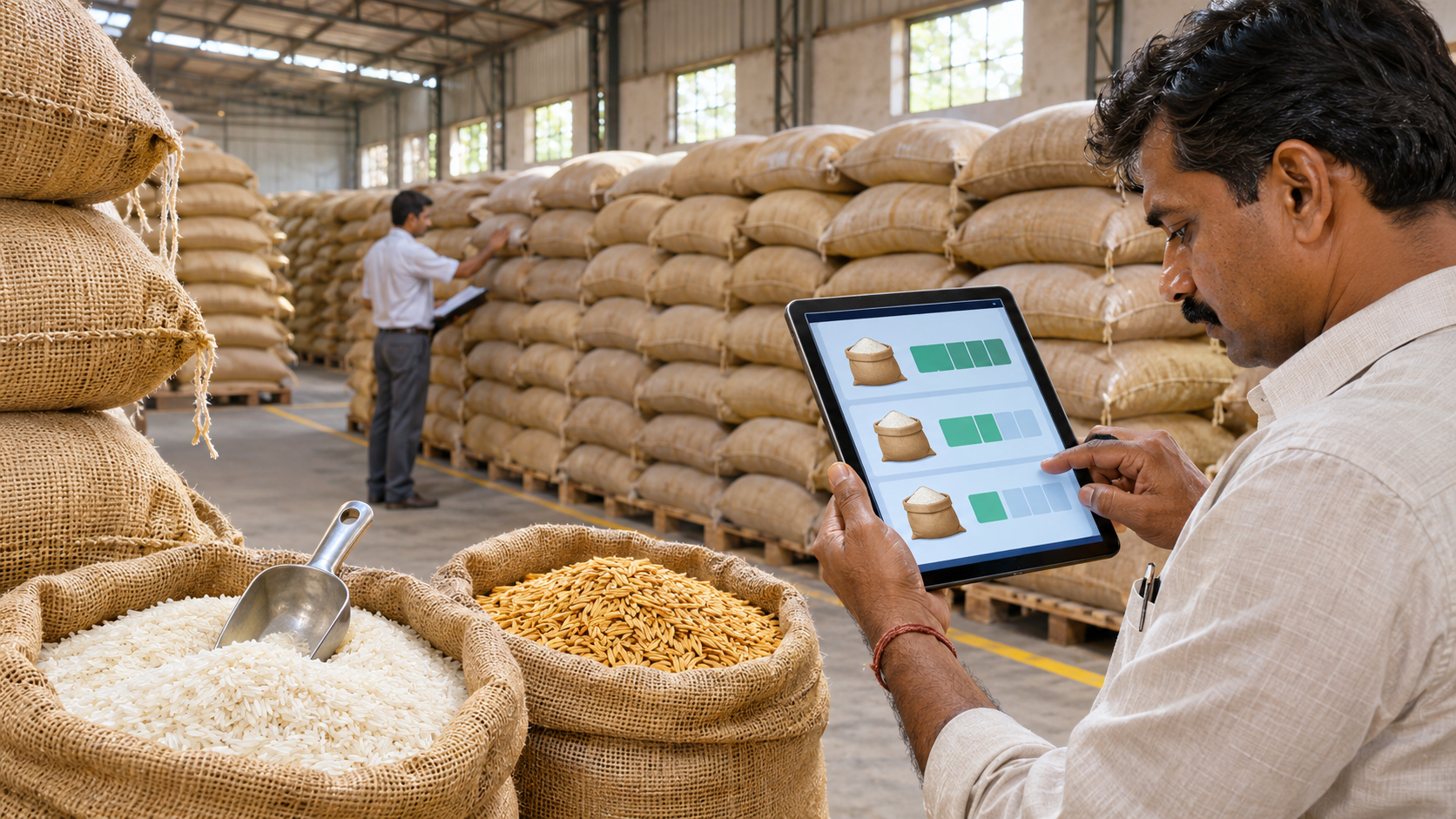
The government has mandated weekly disclosure across six rice and paddy categories and expanded open-market supplies to improve availability and contain prices.
Highlights:
- Rice and paddy stock declaration portal is now operational.
- Traders, retailers, wholesalers, processors and millers must report stocks.
- Details must be updated every Friday across six categories.
- Non-compliance can attract action under the Essential Commodities Act.
- Rice e-auction sales target has doubled to 50 lakh tonnes.
- Additional supplies will support Bharat Rice distribution.
New Delhi, November 14: The Centre has operationalised an online portal for mandatory declaration of rice and paddy stocks by businesses, stepping up efforts to prevent hoarding, improve supply visibility and contain rising prices.
The food ministry announced the portal’s activation in a social media post on Saturday. Under a November 6 order, traders, wholesalers, retailers, large retail chains, processors and millers across all states and Union Territories must disclose their stocks.
Weekly disclosure across six categories
Every unit holding stocks must update its details on the Food Stock Portal, foodstock.dfpd.gov.in, every Friday.
The requirement covers six categories: Basmati rice, non-Basmati premium rice, non-Basmati rice, parboiled rice, broken rice and paddy. Category-wise reporting will give authorities greater visibility into availability across different segments of the market.
According to the order, units that remain unregistered on the portal or violate applicable stock limits will face action under Sections 6 and 7 of the Essential Commodities Act, 1955.
Centre expands rice supplies
Alongside stock monitoring, the government is allocating additional rice to NAFED, NCCF and Kendriya Bhandar for sale under the Bharat Rice initiative. These agencies have been asked to explore all possible distribution channels, particularly in southern states.
The Centre has also doubled its rice sales target through e-auctions under the Open Market Sale Scheme (Domestic) for 2026-27 to 50 lakh tonnes from 25 lakh tonnes.
Around 25 lakh tonnes had been sold to private parties by October 31, compared with 11 lakh tonnes during the corresponding period a year earlier.
Price pressure varies across regions
The measures come amid higher rice prices. Retail rice inflation rose to 8.25% year-on-year in September from 5.89% in August. The average retail price stood at around ₹48.23 per kg, about 12% higher than a year earlier.
Trade and industry experts attributed pressure, particularly in premium non-Basmati varieties, to deficient and uneven rainfall, which has also lifted paddy prices in several markets.
However, experts said the situation does not amount to a nationwide crisis. Government stocks remain comfortable, while shortages are more pronounced in specific regions and rice grades.
Kharif paddy acreage for 2026-27 declined by about 4% to 42.68 million hectares. Trade estimates place rice production at around 147 million tonnes, compared with a record 154 million tonnes in 2025-26.