Nearly 70% of the targeted segments under the government’s Production Linked Incentive scheme are broadly on track, according to a NITI Aayog assessment. Electronics, telecom and pharmaceuticals have emerged as strong performers, while cumulative investments under the scheme reached ₹2.40 lakh crore by March 2026.
New Delhi, November 12 — Nearly 70% of the targeted segments under India’s Production Linked Incentive (PLI) scheme are broadly on track, with particularly strong results in electronics, telecom and pharmaceutical drugs, according to a NITI Aayog report.
The ‘Impact Assessment of PLI Schemes’ said the programme is beginning to generate meaningful additionality across several sectors.
As of March 2026, the PLI schemes had attracted cumulative investments of ₹2,40,138 crore and generated production worth ₹22,66,412 crore.
The schemes have also created employment for 8,49,069 individuals, while ₹35,354 crore has been disbursed as incentives.
Electronics emerges as strong performer
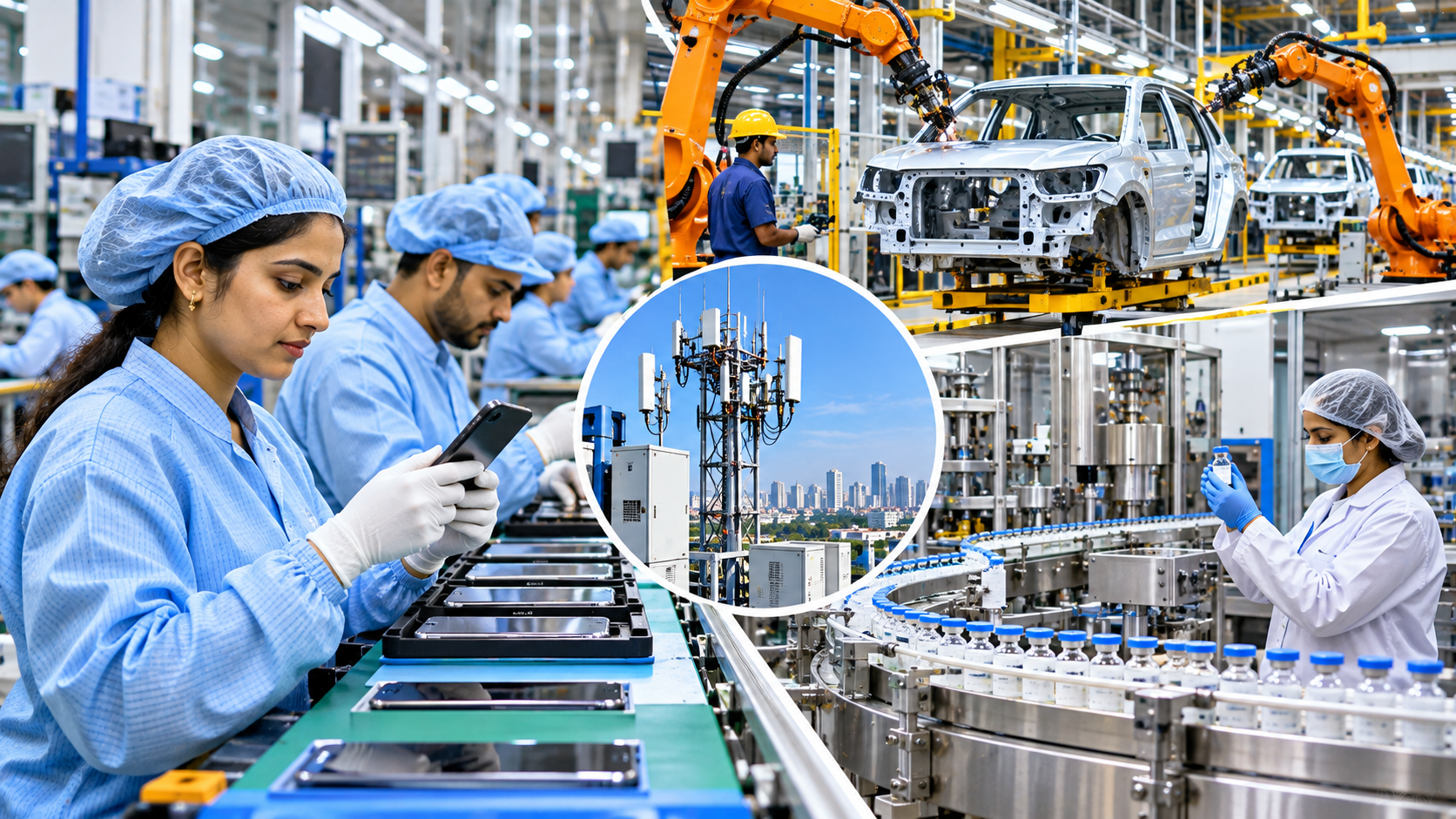
Large Scale Electronics Manufacturing (LSEM) has emerged as one of the strongest performers under the programme.
The scheme has an outlay of ₹34,193 crore and has delivered significant growth, particularly in mobile manufacturing.
According to NITI Aayog, the segment has recorded strong performance in production, sales, exports and employment across both domestic and global companies.
The PLI programme has been introduced across 14 sectors to strengthen domestic manufacturing, attract investment, generate employment, boost exports and develop globally competitive manufacturing capabilities.
₹1.91 lakh crore total PLI outlay
The 14 PLI schemes have a combined financial outlay of ₹1,91,049 crore.
Against this, cumulative incentive disbursements stood at ₹35,354 crore as of March 2026, equivalent to 18.51% of the total outlay.
However, NITI Aayog said progress varies across industries because of differences in scheme maturity, investment cycles and sector-specific characteristics.
Auto, telecom and steel show progress
Sectors including automobiles and auto components, telecom and speciality steel have demonstrated encouraging progress, particularly in investment and production.
However, the report said these sectors require further improvement in areas including employment, exports and domestic value addition.
Relatively newer or capital-intensive sectors, such as Advanced Chemistry Cell (ACC) batteries and advanced electronic components, remain at an early stage, with substantial investments still going towards capacity creation and commissioning.
Releasing the report, NITI Aayog Vice Chairman Ashok Kumar Lahiri said manufacturing has long been an engine of employment, innovation and productivity-led growth.
He said strengthening India’s manufacturing capabilities would be central to achieving the country’s Viksit Bharat @2047 vision and sustaining high, inclusive and broad-based economic growth.