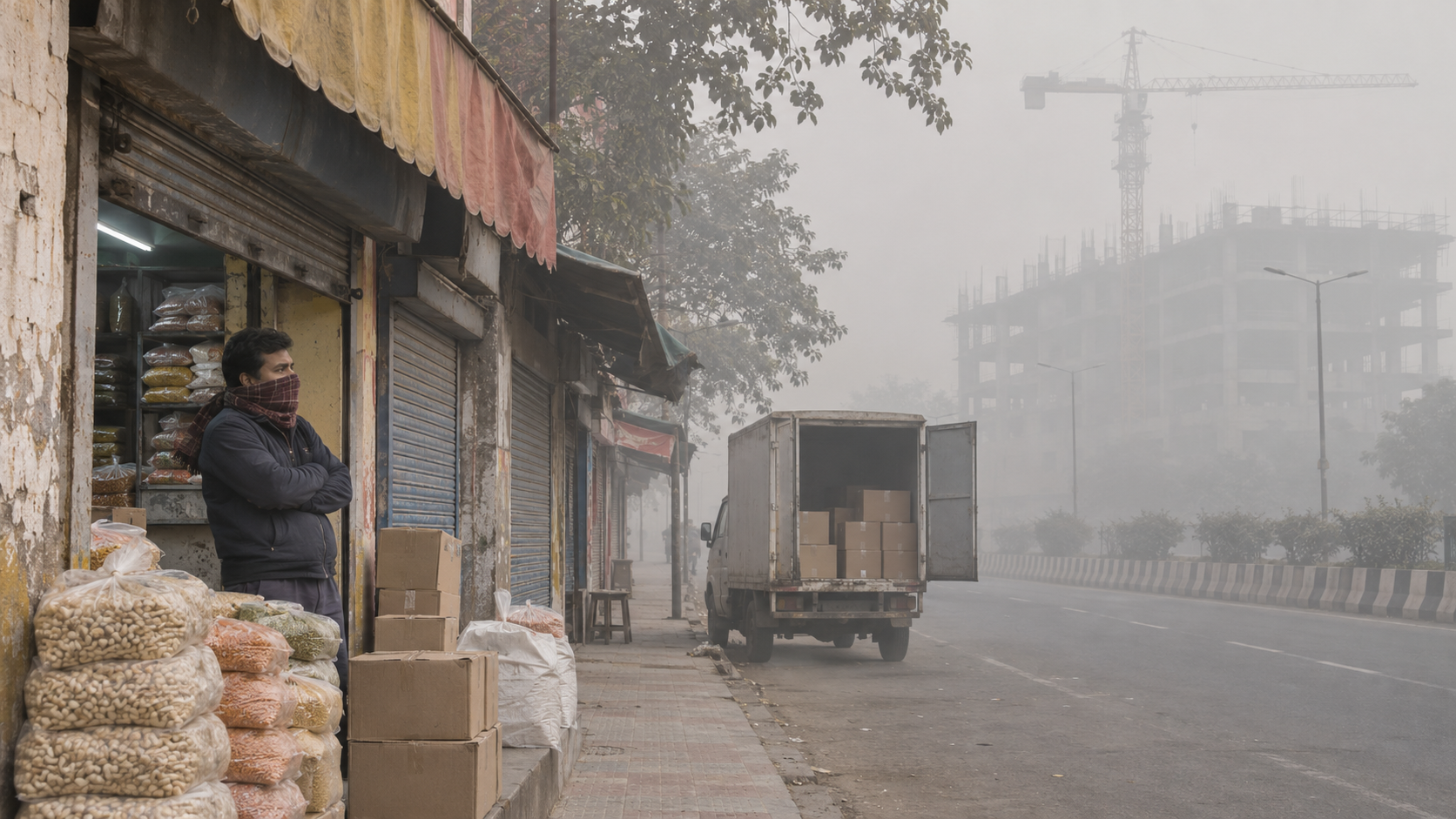
Delhi-NCR’s latest pollution curbs show how a spell of bad air can hit retailers, transporters and daily-wage workers at the same time.
Highlights
- Delhi’s air quality index was 307 at 7 am on November 10, still in the ‘very poor’ category.
- The Commission for Air Quality Management invoked Stage III of GRAP on November 6 across the National Capital Region.
- Retailers reported weaker footfall during last winter’s pollution spells, and one restaurant operator said higher delivery orders failed to offset the loss of diners.
- Construction curbs could affect nearly 10 lakh workers in Delhi-NCR, according to industry representatives
New Delhi, November 10 — For a Delhi shopkeeper, a bad-air day can mean fewer customers. For a construction worker, it can mean a missed shift. And for a transporter, restrictions on older commercial vehicles can make a routine delivery slower and more expensive. Delhi’s air quality index stood at 307 at 7 am on Tuesday, keeping the city in the ‘very poor’ category even after an improvement from Monday morning.
Fewer shoppers, quieter restaurants
The last winter offers an indication of what businesses face. Shoppers Stop told The Economic Times that elevated pollution in northern India contributed to flat sales in the October–December quarter. Lifestyle International also reported weaker footfall and sales growth in the region. A Gurugram restaurant operator told the publication that deliveries rose by around 15% during a pollution spell, but the extra orders fell short of making up for the drop in dine-in traffic. Those accounts describe last winter. Comparable sales figures for the current spell are still awaited.
Construction and freight feel the pressure
The Commission for Air Quality Management invoked Stage III of the Graded Response Action Plan across the NCR on November 6. A separate precautionary order restricted dust-generating construction and demolition from November 5 to 20 in Delhi and five neighbouring districts. Industry representatives told Moneycontrol that the curbs could affect nearly 10 lakh workers. Paused projects can also delay orders for materials such as cement, steel and tiles, while restrictions on older goods vehicles can push up the cost of moving supplies.
What the economic estimates show
A study by Dalberg Advisors, the Clean Air Fund and the Confederation of Indian Industry estimated that air pollution cost Indian businesses $95 billion in 2019. It traced the losses to missed work, lower productivity, reduced consumer footfall and premature deaths. A recent FICCI–EY paper cited a separate, broader estimate based on 2022 data that put the economic burden at the equivalent of 9% to 9.5% of GDP, accounting for factors such as illness, lower worker productivity and premature deaths. The two estimates cover different years and measure different costs.
Full reports · The Economic Times · FICCI–EY pape