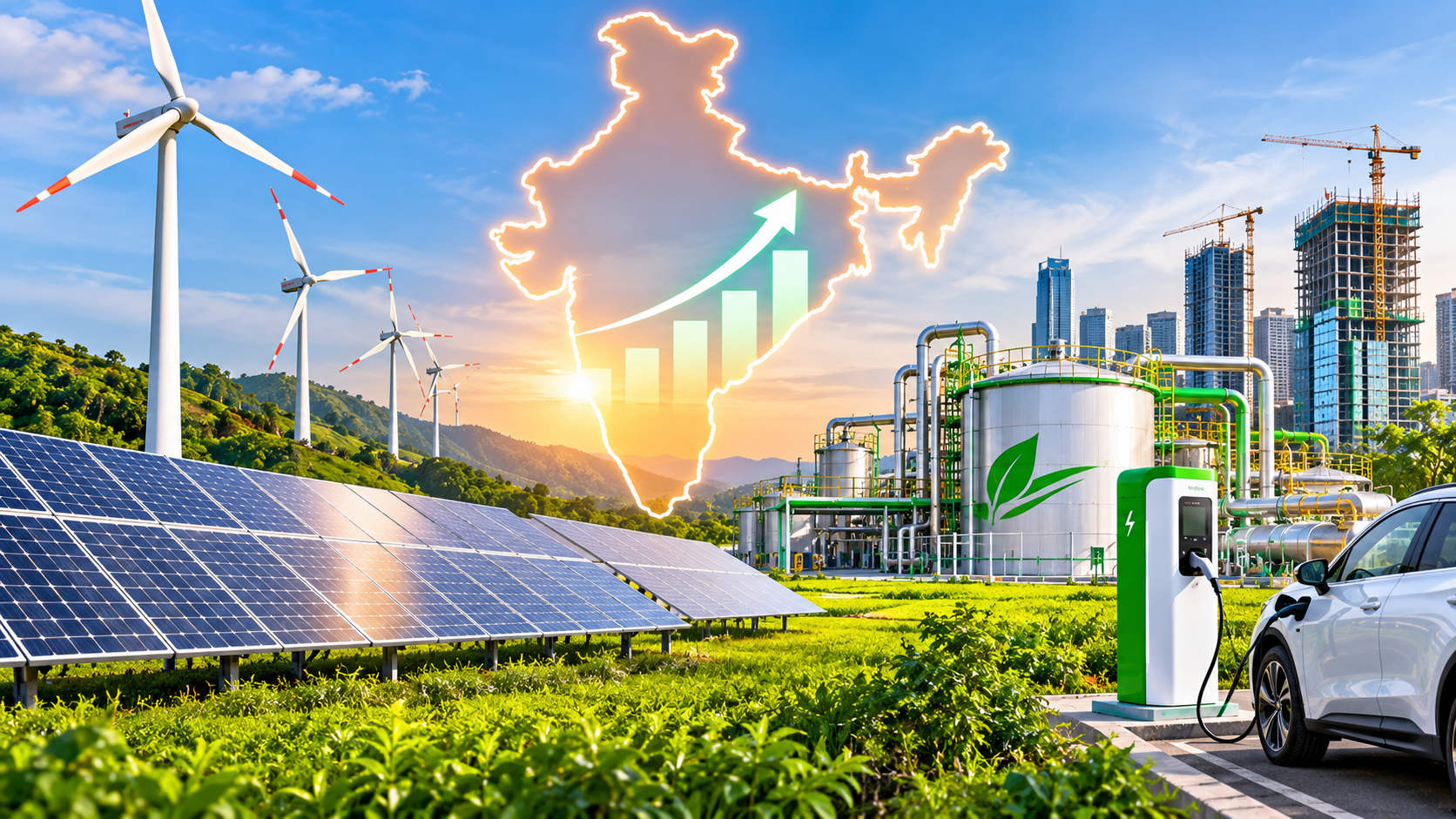
A new report by Australian economist Nicki Hutley highlights massive investment opportunities in renewable energy, electricity grids, battery storage and green hydrogen as India pursues its 2070 net-zero target.
Highlights
- India’s net-zero transition could require $22.7 trillion in investment by 2070.
- The country faces an estimated $6.5 trillion financing gap.
- Domestic resources could cover just over 70% of investment requirements.
- Renewable energy, battery storage and green hydrogen offer major opportunities.
- Non-fossil sources accounted for 54.2% of installed power capacity by June 2026.
- International capital will be crucial to achieving India’s climate and development goals.
India’s Net-Zero Ambition Creates $22.7 Trillion Investment Opportunity, Report Says
New Delhi, November 9, 2026: India’s ambitious target of achieving net-zero carbon emissions by 2070 could unlock an estimated $22.7 trillion investment opportunity, positioning the country as one of the world’s largest markets for clean energy and climate-related infrastructure.
According to a report titled India’s Net Zero Transition is the World’s Net Zero Transition, authored by Australian economist Nicki Hutley, India’s shift towards a low-carbon economy will create significant opportunities for global investors across renewable energy, electricity grids, battery storage, green hydrogen and industrial decarbonisation.
India Faces $6.5 Trillion Funding Gap
The report estimates that India could finance just over 70% of its net-zero investment requirements through domestic resources. However, a funding gap of approximately $6.5 trillion would require substantial international financial support.
Foreign investors, development finance institutions and global financial markets are expected to play a critical role in bridging this gap.
The report argues that India’s energy transition should be viewed not merely as an environmental obligation but also as a major long-term economic opportunity.
Renewable Energy and Green Technology to Drive Investment
Major investment opportunities are expected in solar and wind power generation, electricity transmission and distribution, battery storage, green hydrogen, electric mobility and cleaner industrial technologies.
India has already made progress in expanding non-fossil electricity capacity, which accounted for 54.2% of the country’s total installed power capacity by June 2026.
However, renewable energy contributed only around one-quarter of actual grid electricity generation, highlighting the need for further infrastructure investment.
Balancing Economic Growth With Climate Goals
India remains the world’s third-largest greenhouse gas emitter in absolute terms, but its per-capita emissions are significantly below the global average.
According to the report, India’s per-capita emissions stand at approximately 3.1 tonnes of carbon dioxide equivalent, compared with the global average of 6.6 tonnes.
With GDP per capita estimated at $2,810, India must continue expanding its economy while transitioning towards cleaner energy sources.
Global Investment Crucial for Net-Zero Transition
India aims to become a developed economy by 2047 while achieving net-zero emissions by 2070.
Growing urbanisation, industrialisation, air-conditioning demand and expanding data centres are expected to increase electricity consumption substantially.
The report cautions that high financing costs, regulatory uncertainty, inadequate grid infrastructure and financial challenges faced by electricity distribution companies could slow investment.
It concludes that India’s ability to combine economic growth with clean energy expansion will be critical not only for its domestic development but also for global climate objectives.