India’s proposed rear-impact safety mandate for passenger vehicles from April 2029 could add around ₹2,700 crore annually to manufacturing costs, as automakers may need stronger rear structures, fuel-system protection and other safety upgrades.
New Delhi — India’s proposed rear-impact safety regulation for passenger vehicles from April 2029 could significantly increase manufacturing costs for automakers, with the industry facing an estimated additional burden of around ₹2,700 crore annually.
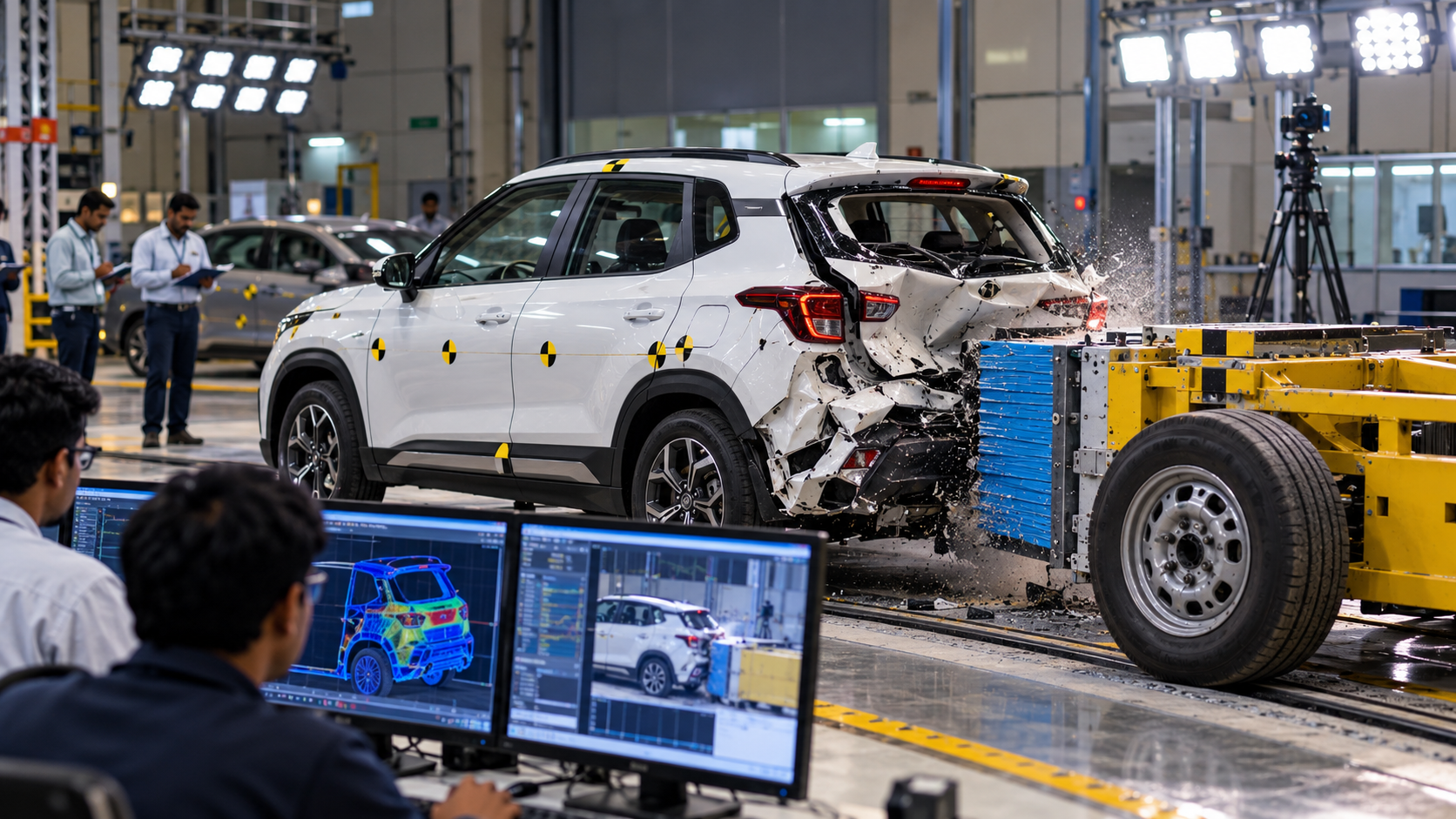
The new safety requirement is expected to apply to passenger vehicles and would require manufacturers to strengthen the rear portion of vehicles so they can better withstand collisions from behind.
Industry experts cited in the report estimate that complying with the regulation could add around ₹5,000 per small car, ₹4,000 per hybrid vehicle and ₹15,000 for sedans.
At an assumed market share of roughly 35% for small cars, 30% for SUVs and 35% for other passenger vehicles, the total annual cost impact for the industry could reach about ₹2,700 crore.
The rule could require automakers to redesign several vehicle components.
These may include stronger rear longitudinal members, reinforced cross-members, improved crash structures and stronger fuel-tank protection.
Fuel-system safety is expected to be one of the key areas of focus.
Vehicles with conventional engines and hybrids may need additional fuel-tank brackets, shields and structural reinforcements to reduce the risk of fuel leakage or fire during rear-end collisions.
Electric vehicles could face a different set of engineering requirements.
EVs may require changes to battery mounting brackets, rear underbody protection, electrical isolation systems and redesigned high-voltage connectors.
Hybrid vehicles may face some of the highest engineering complexity because they combine fuel systems with high-voltage battery components.
The rule could therefore require modifications across both conventional and electrified vehicle architectures.
The report notes that automakers already meeting similar international crash-safety standards may be able to absorb some of the changes through existing vehicle platforms.
However, entry-level cars and models designed primarily for cost-sensitive segments could face greater pressure because additional safety equipment may represent a larger share of their manufacturing cost.
The Ministry of Road Transport and Highways is expected to make the rear-impact safety requirement applicable to passenger vehicles from April 1, 2029.
The measure is part of a broader push to improve vehicle crashworthiness and passenger protection in India.
For automakers, the challenge will be balancing stronger safety requirements with affordability, particularly in the highly price-sensitive small-car market.