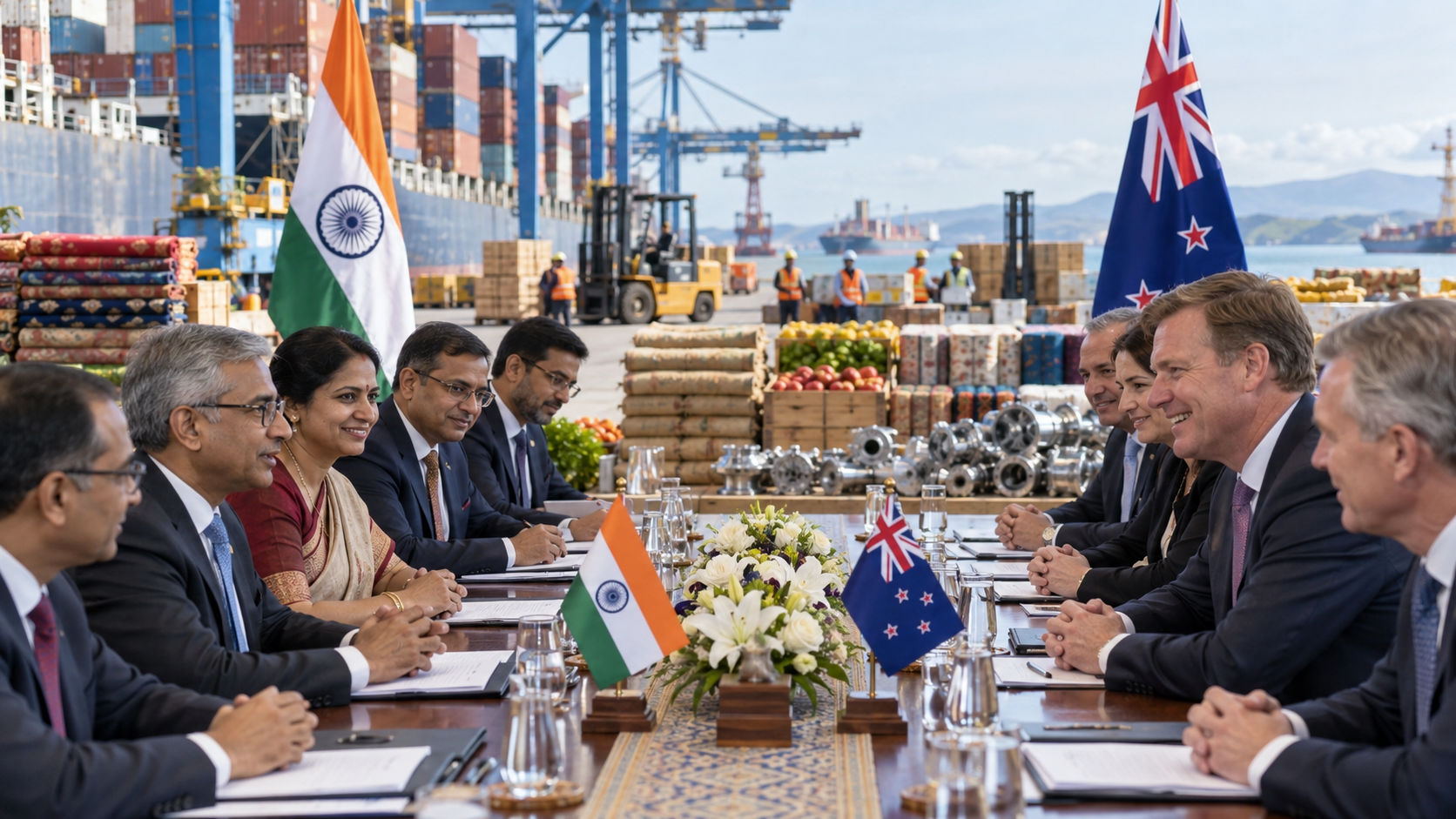
The India-New Zealand Free Trade Agreement has come into effect, giving Indian exports duty-free access to New Zealand and expanding opportunities across goods, services, investment, skills and mobility.
New Delhi, October 20 — The India-New Zealand Free Trade Agreement (FTA) came into force on Tuesday, opening up duty-free access for a wide range of Indian exports and marking another major expansion of India’s trade agreement network.
The agreement was signed on April 27, 2026 and follows negotiations that were originally launched in 2010, stalled in 2015 and revived in March 2025.
With its implementation, the pact becomes India’s 17th operational FTA and the seventh trade agreement to come into force in the last five years.
The other recent agreements include trade pacts with the UAE, Mauritius, European Free Trade Association bloc, the UK, Oman and Australia.
One of the most important features of the agreement is that 100% of Indian exports will receive duty-free access to New Zealand from day one.
Sectors expected to benefit include textiles and apparel, leather and footwear, engineering goods and auto components, gems and jewellery, agriculture and processed foods, pharmaceuticals and other manufacturing industries.
New Zealand Prime Minister Christopher Luxon said the deal would give businesses easier access to more than a billion additional customers and support higher sales, investment, employment and wages.
The agreement also goes beyond merchandise trade.
It includes provisions covering services, investment, skills and mobility, creating opportunities for Indian professionals, students and service providers.
Trade experts highlighted market access in areas such as Ayush services, yoga instructors and student mobility, including post-study work visas.
New Zealand has also committed FDI worth $20 billion over more than 15 years.
Experts said provisions related to duty-free inputs, bilateral cumulation, customs facilitation and investment promotion could improve value-chain integration and create a more favourable environment for investment.
The two countries have set a target of doubling bilateral trade by 2030.
Bilateral trade had declined around 11% to $1.15 billion in 2025-26, compared with $1.3 billion in the previous financial year.
India exported goods worth $566.51 million to New Zealand, while imports stood at $589.1 million, resulting in a relatively small trade deficit of $22.59 million.
The operationalisation of the FTA is expected to improve competitiveness for Indian exporters, particularly MSMEs in labour-intensive industries, while deepening economic ties between the two countries.