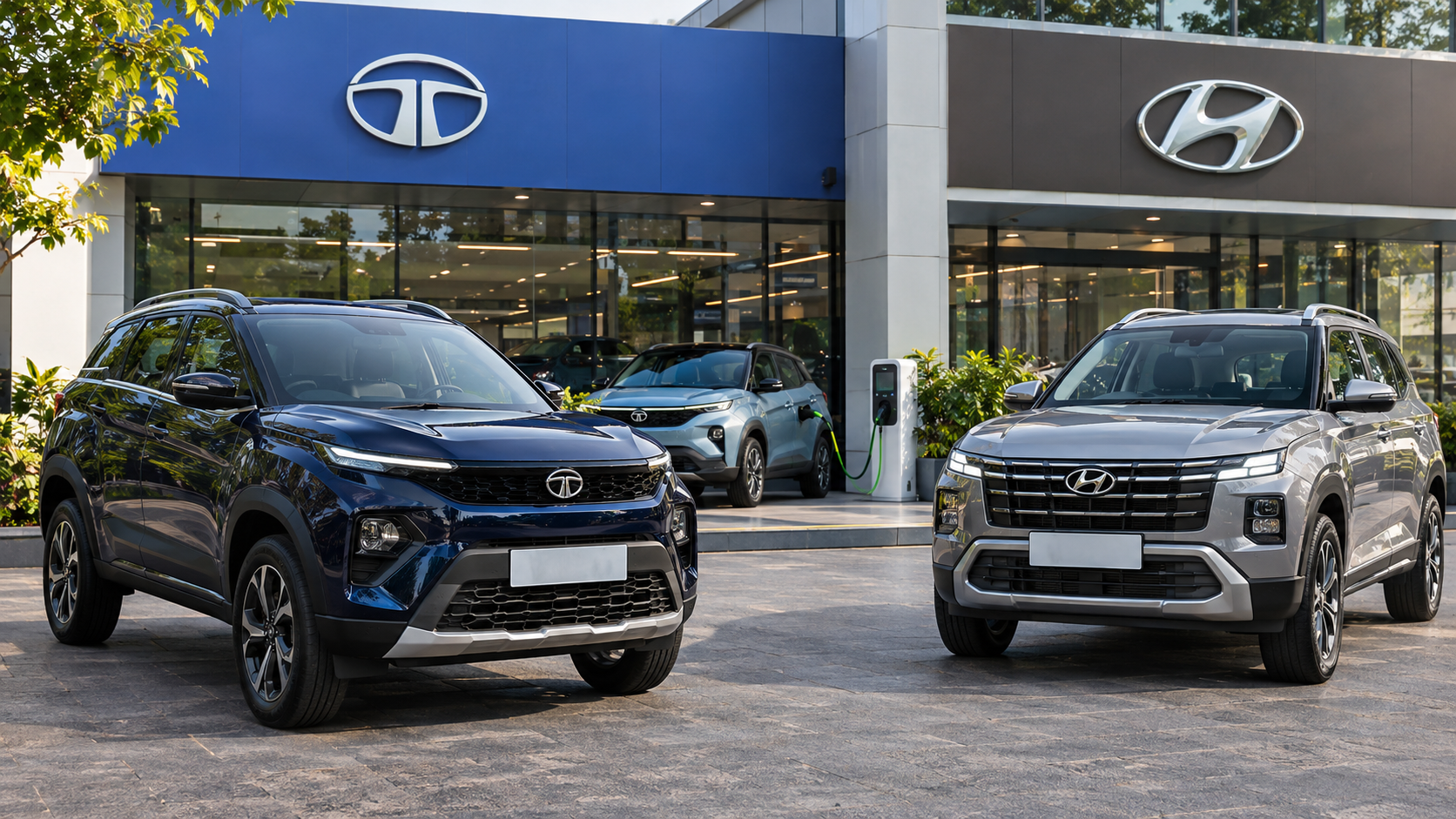
Both automakers will revise prices from December 1, 2026, to partly offset rising input costs, with Auto stocks in focus as Tata Motors PV announces 0.5% price hike; Hyundai to raise prices by up to ₹8,000increases varying across models and variants.
Highlights:
- Tata Motors PV announces an average price increase of 0.5%.
- Revision covers its entire ICE and electric vehicle portfolio.
- Hyundai will increase prices by up to ₹8,000 on select models and variants.
- Both revisions take effect on December 1, 2026.
- Higher input costs prompted the announcements.
Tata Motors Passenger Vehicles and Hyundai Motor India are in focus after announcing vehicle price increases effective December 1, 2026. The revisions will pass part of the burden of higher input costs on to customers, making affected cars and SUVs more expensive next month.
Tata Motors Passenger Vehicles will increase prices by an average of 0.5% across its entire passenger vehicle range, including internal combustion engine (ICE) models and electric vehicles. The company announced the decision on November 24, saying the actual increase would differ across models and variants.
The automaker said input costs continued to remain elevated. Although it was absorbing a substantial share of the additional expense, it would pass some of the impact on to customers through the December revision. The increase is intended to partially compensate for these cost pressures.
For buyers, the portfolio-wide average does not mean every Tata vehicle will become exactly 0.5% more expensive. The additional amount will depend on the model and variant. Its announcement establishes the overall revision, rather than providing a detailed list of updated vehicle prices.
Hyundai Motor India, meanwhile, will raise prices by a maximum of ₹8,000 on selected models and variants. The company also attributed its decision to increased input costs, after seeking to contain the impact through operational efficiencies and cost optimisation.
The two announcements differ in scope. Tata’s revision covers its complete ICE and EV portfolio, while Hyundai’s applies to selected offerings. Likewise, Hyundai’s ₹8,000 figure represents the upper limit of the announced increase, rather than a uniform addition to every affected vehicle’s price.
Customers planning a December purchase will therefore need the revised price for their chosen model and variant to assess the actual impact. Comparing the updated vehicle quotation with the earlier price will show how much their purchase budget changes.
For the auto sector, the announcements highlight the continuing challenge of balancing higher production costs with vehicle affordability. They also put pricing decisions in focus as manufacturers seek to recover part of their increased expenses while limiting the burden on customers.