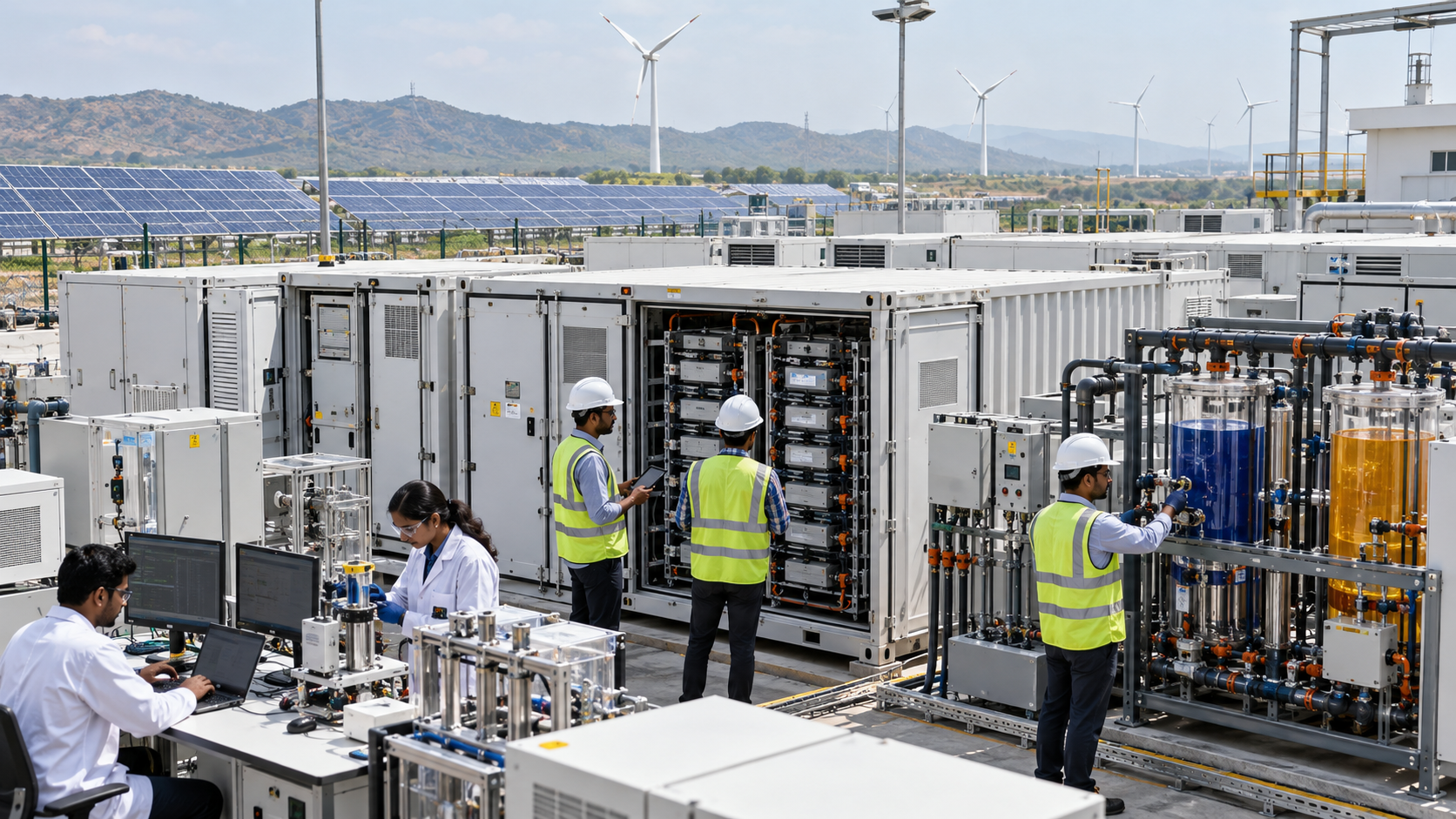
Non-lithium energy storage technologies such as sodium-ion, vanadium redox flow, zinc-based and iron-based batteries could help India reduce its battery storage import dependence to around 50–52% by 2035, according to a NETRA survey.
New Delhi, October 14 — India’s battery energy storage sector could see a major shift toward non-lithium technologies over the next decade, with domestic innovation and manufacturing expected to significantly reduce dependence on imported storage systems.
According to a survey by the NetZero Energy Transition Association (NETRA), nearly 90% of India’s current storage and lithium-ion battery requirements are still met through imports. However, wider adoption of technologies such as vanadium redox flow, sodium-ion, zinc-based and iron-based batteries could bring import dependence down to around 50–52% by 2035.
The survey was conducted among industry leaders, utilities, battery manufacturers, project developers, researchers and manufacturers across Delhi, Mumbai, Bengaluru, Chennai and Hyderabad.
The findings are set to be formally presented at the Beyond Lithium Summit 2026 in New Delhi on October 24. More than 100 companies and research organisations are expected to participate, focusing on technologies beyond conventional lithium-ion batteries.
India’s Battery Energy Storage System sector is already expanding rapidly. Industry estimates cited in the report suggest that BESS capacity could rise from 6.3 GWh to 302 GWh between FY26 and FY32, representing a compound annual growth rate of around 91%.
The need for diversification has become more urgent because 89–91% of battery storage systems and lithium-ion batteries are currently imported, exposing India to global supply disruptions, currency volatility and raw material price swings. Lithium battery prices in India moved by more than 25% over the past year, according to the survey.
Around 61% of respondents believe that scaling domestic innovation and production in alternative battery chemistries can meaningfully reduce import dependence. More than half expect the share of imported storage systems to fall to 50–52% by 2032 if commercial deployment and investment accelerate.
Indian research institutions including ARCI, IMMT, NCL and IIT Bombay are working on indigenous sodium-ion cell technologies. Companies such as Rechargion, HPCL, Oden Energy, Macsen Energy and Uneverse are also developing battery cell and pack solutions for grid and industrial applications.
On the vanadium flow side, companies such as VFT and Delectrik Systems are deploying long-duration storage systems in India and overseas.
NETRA President Rahul Walawalkar said India’s energy security would depend not only on the amount of storage deployed but also on the diversity and indigenisation of the technologies behind it.