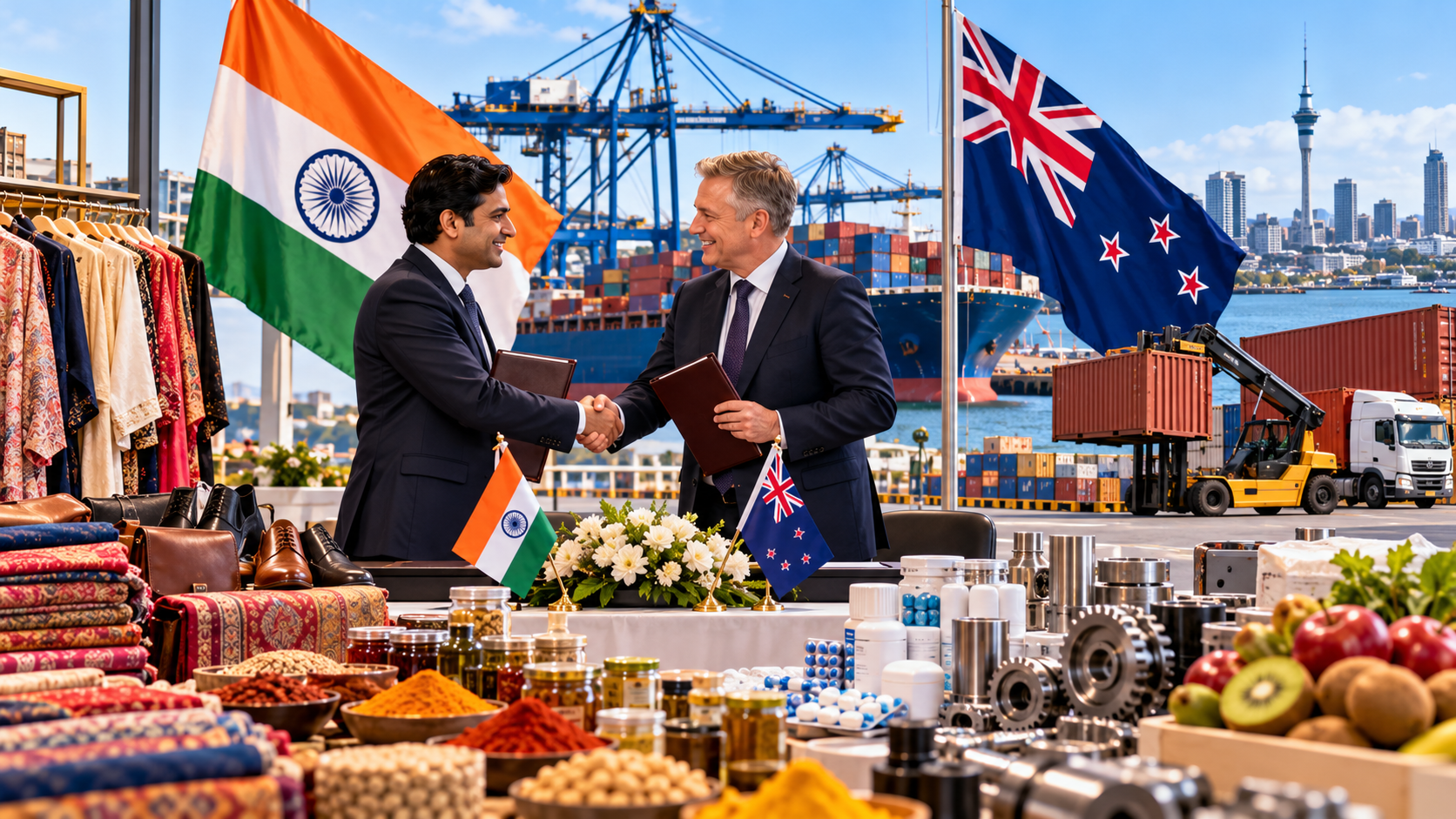
The India-New Zealand Free Trade Agreement has come into force, giving Indian exporters zero-duty access across all New Zealand tariff lines while expanding opportunities in services, investment, professional mobility and agriculture.
New Delhi, October 21 — The India-New Zealand Free Trade Agreement (FTA) has officially come into force, giving Indian exporters zero-duty access across 100% of New Zealand’s tariff lines and opening new opportunities for trade, investment and services.
The agreement aims to increase bilateral trade in goods and services from around $2.4 billion to NZ$7 billion, or about ₹35,000 crore, by 2030, according to Commerce Minister Piyush Goyal.
Indian labour-intensive sectors such as textiles, apparel, leather, footwear and carpets are expected to benefit significantly. Other beneficiaries include engineering goods, pharmaceuticals, plastics and rubber, electrical and mechanical machinery, chemicals and processed foods.
New Zealand imported goods worth around $47.5 billion in 2025, while India accounted for just 1.9% of those imports, indicating substantial headroom for Indian exporters.
India’s goods exports to New Zealand stood at $566.5 million in 2025-26.
The agreement also covers services and mobility.
New Zealand has offered market access across 118 services sectors and sub-sectors and most-favoured-nation treatment in 139 sectors.
The pact provides 5,000 professional visas for skilled Indians as well as 1,000 one-year multiple-entry working-holiday visas. Students will be allowed to work at least 20 hours a week, while doctoral graduates can receive post-study work opportunities of up to four years.
Pharmaceutical and medical-device companies are also expected to benefit from faster regulatory pathways and recognition of inspections by comparable regulators in markets such as the US, EU, UK and Canada.
New Zealand, meanwhile, will receive preferential access across 70% of India’s tariff lines, with 30% of those lines getting immediate tariff elimination. Other concessions will be phased in over up to 10 years.
Sensitive Indian sectors remain protected. India has excluded products including dairy, sugar, onions, chickpeas, peas, corn, almonds, certain fats and oils, gems and jewellery, copper, aluminium and arms and ammunition.
The agreement also provides for faster customs clearance — within 48 hours for cargo and 24 hours for express and perishable consignments.
Digital certification and self-certification of rules of origin are expected to reduce procedural delays and compliance costs.