

Wipro Consumer Care will acquire TTK Healthcare’s Good Home and Eva brands for ₹256 crore.The deal strengthens Wipro’s home care and personal care portfolio amid rising demand for premium consumer products. Key Highlights Wipro Consumer Care & Lighting has signed an agreement to acquire TTK Healthcare’s Good Home and Eva brands for ₹256 crore, strengthening its presence in India’s fast-growing home care and personal care market. The acquisition includes the Good Home range of home cleaning products and the Eva fragrance brand. Together, the two brands reported a combined revenue of ₹148 crore in FY2025-26 and have built a strong presence in their respective categories over the years. According to Wipro Consumer Care, the acquisition aligns with its long-term strategy of expanding its consumer products portfolio through strategic investments. The company believes demand for home cleaning, hygiene, air care and personal fragrance products is increasing as consumers become more health-conscious and increasingly prefer premium products. Managing Director Kumar Chander said the acquisition will strengthen Wipro’s presence in categories where consumer demand is witnessing sustained growth. He added that the company plans to retain the existing brand identities while leveraging Wipro’s extensive distribution network, marketing capabilities and product innovation expertise to accelerate growth. For Wipro, this is the 17th acquisition in its consumer care business, highlighting its strategy of expanding through mergers and acquisitions in addition to organic growth. The deal also complements Wipro’s existing portfolio, which includes well-known brands such as Glucon-D, Santoor, Yardley, Chandrika, Nirapara and Brahmins across personal care, food and home care segments. The transaction is expected to be completed by September 2026, subject to customary regulatory approvals. The acquisition reflects growing competition in India’s FMCG sector, where companies are increasingly focusing on premium products and established brands to capture higher consumer spending.

Mercedes Starts E25-Compatible Cars
Mercedes-Benz India has begun rolling out E25-compatible vehicles ahead of future ethanol fuel regulations.The move aligns with India’s biofuel push while the luxury carmaker continues offering both petrol and electric models. Key Highlights Mercedes-Benz India has started rolling out E25-compliant vehicles in the country, becoming one of the early luxury carmakers to prepare for future ethanol-blended fuel regulations. The move comes as India continues to promote biofuels to reduce dependence on imported crude oil and improve energy security. Mercedes-Benz India Managing Director and CEO Santosh Iyer said the company has already upgraded its product portfolio to meet anticipated fuel norms. According to him, all vehicles currently being sold in India are E25 compliant, ensuring they are ready if the government decides to introduce E25 (25% ethanol blend) petrol in the future. At present, the Centre has made E20 petrol (20% ethanol blend) mandatory across the country. While trials on E25 fuel are underway, the government has not yet announced a timeline for its nationwide rollout. By making its vehicles E25-ready in advance, Mercedes-Benz aims to future-proof its products and offer customers greater peace of mind. Iyer noted that the transition to E25 aligns with the German luxury carmaker’s broader strategy of preparing for changing fuel standards while maintaining a wide range of powertrain options for Indian buyers. On the electric mobility front, Mercedes-Benz said customer demand continues to be divided between conventional petrol-powered vehicles and electric models. The company believes consumers increasingly prefer having multiple technology choices rather than shifting entirely to a single powertrain. According to the company, 22–25% of its sales in segments where electric variants are available now come from EVs. However, Iyer added that a significant share of buyers still prefers internal combustion engine vehicles, prompting Mercedes-Benz to continue investing in both electric mobility and cleaner combustion technologies. The rollout of E25-compatible vehicles reflects the company’s long-term strategy of staying ahead of evolving regulations while supporting India’s transition towards cleaner transportation.

ZENO Expands Affordable Portfolio
itel has launched the ZENO 100 Pro smartphone alongside two new fast-charging power banks in India.The new lineup focuses on affordability, durability, long battery life, and everyday performance. Key Highlights itel has expanded its affordable product lineup in India with the launch of the ZENO 100 Pro smartphone and two new ZENO power banks, targeting consumers looking for feature-rich devices at budget-friendly prices. Priced at ₹8,599 as a launch offer on Amazon, the ZENO 100 Pro is positioned as one of the most affordable smartphones in its segment. The company has also introduced the ZENO 100 Lite at ₹7,999, giving buyers another budget option. The ZENO 100 Pro comes with a 6.6-inch HD+ IPS display featuring a 90Hz refresh rate for smoother scrolling and viewing. It is powered by the Unisoc T7100 octa-core processor and runs on Android 15 Go Edition, offering a clean software experience for everyday use. The smartphone includes 3GB RAM with an additional 5GB virtual RAM, 64GB internal storage, an 8MP rear camera, and a 5MP front camera. It also offers a 5,000mAh battery, 10W charging, side-mounted fingerprint sensor, face unlock, IR blaster, and DTS-powered speaker. A standout feature is its MIL-STD-810H military-grade durability certification, while UltraLink connectivity is designed to help users stay connected even in areas with weak network coverage. Alongside the smartphone, itel has launched two new power banks. The 10,000mAh model, priced at ₹1,299, supports 22.5W fast charging, features a digital battery display, dual output ports, and comes with a Type-C cable. The premium 20,000mAh power bank, priced at ₹2,069 (with an additional launch discount), supports 45W fast charging, multiple charging protocols including PD 3.0 and QC 3.0, and can charge compatible laptops, tablets, and smartphones. It also includes an inbuilt Type-C cable and digital battery display. With this launch, itel aims to strengthen its presence in India’s entry-level smartphone and accessories market by offering durable devices with modern features at competitive prices.

Lava Virat V1 Debuts at ₹8,999
Lava has launched the Virat V1, an affordable smartphone featuring a large HD+ display, a 5,000mAh battery, IP64 protection, and Free Service@Home. The handset is available at an introductory price of ₹8,999. Highlights Lava has expanded its smartphone portfolio with the launch of the Lava Virat V1, targeting budget-conscious buyers who want a reliable smartphone with essential features and dependable after-sales service. The Lava Virat V1 sports a 6.75-inch HD+ display, offering a large viewing area for streaming videos, browsing social media, and everyday use. Powering the device is the UNISOC SC9863A processor, designed to handle routine tasks such as calling, messaging, web browsing, and light multitasking. The smartphone comes with 4GB of RAM, along with 4GB of Virtual RAM, helping improve app switching and overall performance. It also includes 64GB of internal storage, providing ample space for apps, photos, videos, and documents. For photography, the device features a 13MP AI dual rear camera setup and a 5MP front-facing camera for selfies and video calls. Keeping the phone running is a 5,000mAh battery, which is designed to deliver all-day battery life under normal usage. The Virat V1 also carries an IP64 rating, offering protection against dust and water splashes, making it more durable for daily use. Continuing its customer-first strategy, Lava is offering Free Service@Home with the Virat V1. The service allows customers to receive after-sales support at their doorstep, eliminating the need to visit a service centre. The Lava Virat V1 is priced at ₹9,999, but will be available at a launch price of ₹8,999. The company has also introduced the Lava Virat V1 5G, priced at ₹12,999, with an introductory launch price of ₹11,999.

Brezza Secures Five-Star Safety Rating
The 2026 Maruti Suzuki Brezza has secured five-star Bharat NCAP ratings for both adult and child occupant protection.The compact SUV scored 30.41 points for adult safety and 43 points for child protection in the crash tests. Highlights The 2026 Maruti Suzuki Brezza has received the highest five-star safety rating in both adult and child occupant-protection categories under the Bharat New Car Assessment Programme. According to the official Bharat NCAP results, the Brezza scored 30.41 out of 32 points for adult occupant protection and 43 out of 49 points for child occupant protection. The rating applies to select variants manufactured from July 2026 onwards. The result makes the updated Brezza one of Maruti Suzuki’s highest-rated models under India’s domestic crash-testing programme. The company is expected to launch the 2026 Brezza facelift on July 24, 2026. Adult protection performance In the frontal offset crash test conducted at 64 kmph, the Brezza scored 14.41 out of 16 points. Protection offered to the driver’s head, neck, pelvis, thighs and ankles was assessed as good. Protection for the chest and parts of the lower legs was found to be adequate. The SUV’s passenger compartment and footwell area were also reported as stable, indicating that the vehicle’s body structure was capable of withstanding additional impact loads. In the side movable barrier test, conducted at 50 kmph, the Brezza secured the maximum 16 out of 16 points. Protection for the head, chest, abdomen and pelvis was rated as good. Child protection performance For the child-safety assessment, Bharat NCAP used dummies representing an 18-month-old child and a three-year-old child. Both were placed in rear-facing child-restraint systems. The Brezza received the maximum 24 out of 24 points in the dynamic crash assessment and 12 out of 12 points for child-restraint-system installation. It received seven out of 13 points in the vehicle-assessment section. Both child dummies secured full marks in the frontal and side-impact evaluations. Safety features The ZXi+ 1.5-litre automatic variant used for the crash test was equipped with six airbags, electronic stability control, seat-belt reminders, front seat-belt pre-tensioners and ISOFIX child-seat mounting points. For buyers, the five-star result strengthens the Brezza’s position in the competitive compact-SUV market, where vehicle safety has increasingly become an important purchase consideration.
Telecom Data Must Stay Local
The Department of Telecommunications has barred communication infrastructure providers from storing or sharing telecom network data outside India.The new framework covers cloud telecom networks, mobile towers, satellite gateways and other digital connectivity providers. Highlights The government has introduced stricter data-localisation rules for communication infrastructure providers, requiring all telecom-related data, logs and network information to be stored within India. Under the new authorisation framework notified by the Department of Telecommunications, authorised entities will not be allowed to route, share or make copies of telecom network data available outside the country. The rules apply to companies operating mobile towers, cloud-based telecom networks, satellite earth station gateways, internet exchange points and other digital connectivity infrastructure. The move is part of the government’s transition from the traditional telecom licensing system to a broader regulatory framework under the Telecommunications Act, 2023. What changes for telecom providers? Every newly authorised entity will have to ensure that its telecom systems and associated data remain within India. This includes operational logs, network information and other data linked to telecom infrastructure. The government will also have the power to inspect sites where telecom equipment and networks are installed. These inspections may include facilities located on a customer’s premises. Authorities can appoint designated agencies to audit systems, processes and compliance arrangements established by telecom providers. In cases where immediate action is considered necessary in the public interest, the government may conduct inspections without giving prior notice. However, the framework says the inspecting agency should not demand information whose disclosure could damage the competitive position of the telecom provider or its customer. Network rollout responsibility Infrastructure providers will be solely responsible for obtaining permissions needed to build and expand their networks. The government has clarified that delays in receiving right-of-way approvals or the non-availability of such permissions will not be accepted as valid reasons for failing to meet regulatory obligations. This means telecom infrastructure companies will need to plan permissions, land access and network deployment more carefully. Who will come under the rules? The framework applies to infrastructure providers, digital connectivity infrastructure companies, internet exchange point operators, satellite earth station gateway providers, cloud-hosted telecom network providers and national-level mobile number portability providers. For consumers, the rules are aimed at improving control over sensitive telecom information and strengthening national data security. For companies, however, they could require higher investment in domestic servers, cloud systems, cybersecurity and compliance infrastructure.
US Cuts India Tariff Rate
The United States has reduced the proposed Section 301 tariff on Indian exports to 10% after India banned imports of goods made with forced labour.The new tariff replaces the temporary Section 122 regime and applies to most manufactured exports from July 24. Highlights By : Ajay Srivastava New Delhi: The United States has reduced the proposed tariff on Indian exports under its Section 301 forced-labour investigation from 12.5% to 10%, providing partial relief to Indian exporters. The revised tariff came after India amended its Foreign Trade Policy to prohibit imports of goods produced using forced or compulsory labour.The final decision, announced by the Office of the US Trade Representative (USTR), came into effect on July 24, 2026, replacing the temporary Section 122 global tariff that had been in place since February. According to the USTR, 60 economies were reviewed for their efforts to prevent trade in goods produced with forced labour. India has been placed in the lower 10% tariff band along with 16 other economies, while 43 countries will face a higher 12.5% tariff. For Indian exporters, the biggest impact will be on manufactured goods. Around 70% of India’s exports to the US—including engineering products, textiles and garments, chemicals, machinery, plastics, leather goods, gems and jewellery, furniture and several other manufactured products—will now be subject to the normal US MFN duty plus the new 10% Section 301 tariff. Products already covered under Section 232, such as steel, aluminium, copper products, automobiles and auto components, will continue to attract 25% to 50% tariffs, with no change under the latest announcement. The US has also provided exemptions for several categories, including critical raw materials, selected industrial inputs, medical supplies, humanitarian goods and products covered under US free trade agreements. Goods shipped before July 24 and entering the US by July 28 are also exempt under the transition rules. The Global Trade Research Initiative (GTRI) has criticised the decision, arguing that the United States has not presented credible evidence that India imports goods made with forced labour. It noted that India has already strengthened its trade policy by banning such imports and already has domestic laws prohibiting forced labour. GTRI also warned that the Trump administration is expected to announce the outcome of another Section 301 investigation into excess manufacturing capacity, which could result in additional tariffs on industrial products. It added that future country-specific tariffs on India cannot be ruled out, particularly over issues such as Russian oil purchases or broader geopolitical concerns.

Crude at $100: Fuel Impact
Brent crude has climbed above $100 per barrel amid rising West Asia tensions, raising concerns over inflation and India’s import bill.Petrol, diesel and LPG prices remain unchanged for now, but prolonged high oil prices could increase costs across the economy. Highlights Story Rising geopolitical tensions in West Asia have pushed global crude oil prices sharply higher, with Brent crude crossing the $100-per-barrel mark on July 24. The surge has renewed concerns over India’s fuel prices, inflation and overall economic outlook, as the country imports more than 85% of its crude oil requirements. The latest jump in oil prices has been driven by supply concerns following continued disruptions in key shipping routes, including the Strait of Hormuz and the Red Sea. These waterways are among the world’s busiest energy transport corridors, and any disruption directly impacts global crude supplies. Despite the sharp rise in international crude prices, India’s oil marketing companies have not revised petrol and diesel prices. Domestic fuel prices remained unchanged on Friday, providing temporary relief to consumers. LPG prices have also been kept unchanged. According to the latest rates, a 14.2 kg domestic LPG cylinder in Delhi continues to cost ₹942, while the 19 kg commercial cylinder remains priced at ₹2,930. Similar stability has been maintained in other major cities. However, analysts caution that if crude oil continues to trade above $100 for an extended period, pressure on domestic fuel prices could increase. Higher crude prices raise India’s import bill, widen the current account deficit and add pressure on the rupee. The impact goes beyond petrol and diesel. Costlier fuel increases transportation and logistics expenses, which eventually raises the prices of food, consumer goods and other essential products. Industries such as aviation, chemicals, plastics and manufacturing, which depend heavily on petroleum-based inputs, may also face higher production costs. For consumers, the immediate relief is that fuel and LPG prices have not changed. But if geopolitical tensions persist and crude oil remains expensive, the possibility of higher fuel prices and broader inflation cannot be ruled out in the coming weeks.

RBI Sees Limited Food Inflation
Despite delays in kharif sowing due to uneven monsoon, the RBI believes food inflation will remain under control because of ample foodgrain stocks and improving supply conditions. Highlights The Reserve Bank of India (RBI) has said that delays in kharif crop sowing caused by the uneven progress of the southwest monsoon are unlikely to significantly increase food inflation. According to the RBI’s July Bulletin, adequate public foodgrain stocks should help absorb any temporary supply shocks and keep food prices under control. The central bank noted that although rainfall has been uneven across several regions, India’s large foodgrain reserves provide an important buffer against inflationary pressures. This is expected to reduce the impact of delayed sowing on the availability of essential food items in the coming months. According to the India Meteorological Department (IMD), the country received 276.8 mm of rainfall between June 1 and July 21, around 21% below the long-period average. The weather agency has projected seasonal rainfall at about 90% of the long-period average, raising concerns over agricultural output in some regions. Food inflation, however, has already shown some upward movement. Retail food inflation increased to 5.32% in June from 4.78% in May, pushing overall consumer price inflation (CPI) to 4.38%, its highest level in 18 months. The RBI also said that India’s economy continues to remain resilient despite global uncertainties such as supply chain disruptions and geopolitical tensions. Improving rural demand and steady urban consumption are expected to support economic growth in the coming quarters. Separately, the RBI Bulletin showed that household net financial assets moderated to 6.2% of GDP in FY26, as financial liabilities rose during the year. Even so, the central bank believes India’s macroeconomic fundamentals remain strong.
Shipping Crisis Hits Rice
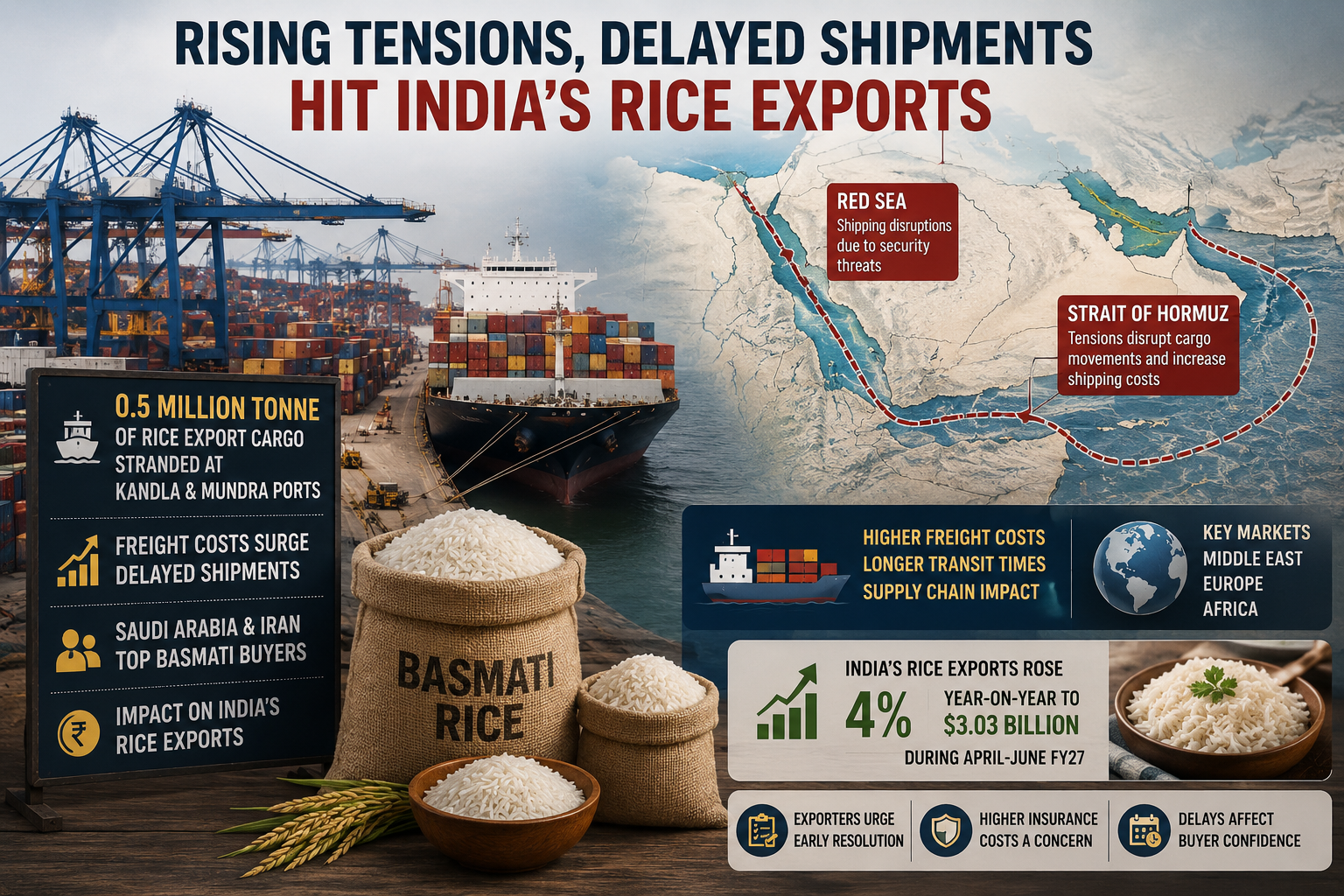
Rising tensions around the Red Sea and Strait of Hormuz are disrupting India’s rice exports, delaying shipments and increasing freight costs for exporters. Highlights India’s rice exporters are facing fresh challenges as geopolitical tensions in West Asia disrupt major global shipping routes through the Red Sea and the Strait of Hormuz. The disruptions have slowed cargo movement, pushed up freight costs and delayed deliveries to important overseas markets. According to industry estimates, nearly 0.5 million tonnes of rice export cargo, including basmati rice, is currently stranded at Kandla and Mundra ports in Gujarat due to uncertainty over shipping schedules. Exporters say the simultaneous disruptions around the Bab al-Mandab Strait and the Strait of Hormuz have created serious logistical challenges. Many shipping lines are taking longer routes to avoid conflict zones, increasing transportation costs and locking up exporters’ working capital as consignments remain delayed. The impact is particularly significant because the Middle East is one of India’s largest markets for premium basmati rice. Saudi Arabia and Iran, together importing nearly 2 million tonnes annually, are among the biggest buyers. Longer delivery times and higher shipping costs could make Indian rice more expensive for customers in the Middle East and Europe. Despite the ongoing disruption, India’s rice exports have remained resilient so far. During the April-June quarter of FY27, rice exports increased by more than 4% year-on-year to $3.03 billion, supported by steady global demand. However, exporters warn that if shipping conditions do not improve soon, higher logistics costs and delayed deliveries could affect India’s competitiveness in international markets and put pressure on future export growth.