
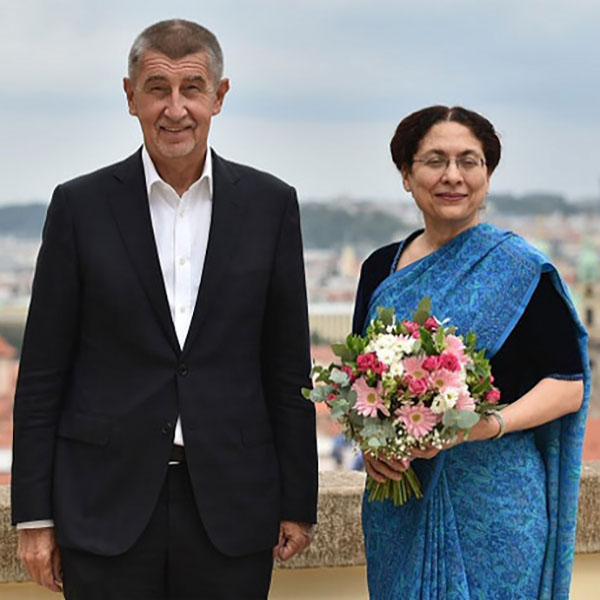
India’s Ambassador to The Czech Republic Mrs. Narinder Chauhan with Mr. Andrej Babis, Prime Minister of the Czech Republic H.E. Mrs. Narinder Chauhan is a seasoned and dynamic diplomat with more than three decades of active service in various key assignments, both in India and abroad. She is presently posted as Ambassador Extraordinary and Plenipotentiary of the Republic of India to The Czech Republic, in which capacity she recently played host to the visit of Hon’ble President of India Shri Ram Nath Kovind to The Czech Republic. The Hon’ble President’s visit to The Czech Republic was also accompanied by a delegation of businessmen wherein some TPCI members accompanied the Hon’ble President to The Czech Republic. Publicity Division of TPCI interviewed this experienced and talented Indian face in The Czech Republic and sought her views on bilateral historical relations between India and The Czech Republic and ways and means to increase the bilateral trade relations between the two countries. Present here are H.E. Mrs. Narinder Chauhan’s views on the highlighted subject: 1. Bilateral Historical Relations : India-Czech Republic India’s trade and cultural relations with Czech Republic have a long history. In the medieval ages the Kingdom of Bohemia (now a part of Czech Republic) traded with India. There are records stating that precious goods including Indian spices were brought to Czechoslovakia from east through marine and land routes as early as 9th and 10th centuries. During the Austro-Hungarian Empire, the Charles University in Prague, the second oldest university in Central Europe, had many Sanskrit scholars. India’s relations with the former Czechoslovakia, and with the Czech Republic, have always been warm and friendly. Gurudev Rabindranath Tagore visited Czechoslovakia in 1921 and 1926. A bust of Tagore is installed in an exclusive residential area in Prague named after Tagore. The Indian leader, who visited Czechoslovakia the most times between 1933 and1938 was Netaji Subhash Chandra Bose. He founded the Indo-Czech Association in Prague in 1934 and met Edvard Benes several times as Foreign Minister and President. Pandit Jawaharlal Nehru accompanied by his daughter Indira Gandhi visited Prague in 1938, and subsequently influenced the strong condemnation of the 1938 Munich Pact by the Indian nationalist movement. Diplomatic relations with Czechoslovakia were established on November 18, 1947. Since then high level visits have been exchanged with Prague, the most recent being the State visit of Rashtrapatiji Shri Ram Nath Kovind in September, 2018 and that of Shri C R Chaudhary, MoS(C&I) in October 2018. 2. Bilateral Trade relations India’s trade links with Czech Republic, formerly Czechoslovakia, predate our independence. Czechoslovakia established its Consulate in Bombay (October 1920) and in Kolkata (December 1929). The famous Czech shoe company Bata Works had 120 Czechoslovak nationals employed in Batanagar in the 1930s. For almost four decades after India’s independence, Czechoslovakia was one of the leading trading partners of India among the East-European countries. Czech companies established a number of major industrial projects in India in the fields of Energy, metallurgy, machine tools and transportation and had about 60 major projects in India before 1990. With the formation of the Czech Republic from January 1, 1993, our trade with the country was switched to freely convertible currencies. The change over and the transformation in economic policies and practices both in India and the Czech Republic resulted in initial slowing down of trade and economic activities between the two countries. New mechanisms and diversified interaction thereafter have resulted in revival of bilateral trade to around USD 1.5 Billion in 2017 from just USD 86 million in 1993. Since 2008, bilateral trade amounted to more than one billion U.S. dollars. In 2013, for the first time in our long history of economic relations, the balance of bilateral trade tilted in India’s favour when Indian exports reached USD 642 million against Czech exports of USD 563 million. Year India’s Exports to CR India’s Imports from CR Bilateral Trade 2014 USD 692 mi USD 589 mi USD 1281 mi 2015 USD 667 mi USD 541 mi USD 1208 mi 2016 USD 734 mi USD 624 mi USD 1358 mi 2017 USD 797 mi USD 670 mi USD 1467 mi (Source: Czech Statistical Office) 3. Factors that could lead to further expansion of trade ties? We consider CR as a leading economic partner. India’s growth story and Czech technological expertise and manufacturing prowess make the two natural partners. Significant Complementarities in economies: India has expertise in fields of IT, Infrastructure, Pharmaceuticals, automobiles and services. Czech companies have expertise in heavy engineering, defence, advanced manufacturing, automotive and energy fields. Technology building: The Czech Republic has niche technological competencies in industrial machinery and plants, machine tools and engineering, and has extensive research and development in areas like nanotechnology, robotics, cybernetics, and lasers. We must also take advantage of these opportunities, through technology tie ups in applied science and engineering fields with the institutions of Czech Academy of Sciences and leading universities. Our Government’s bold reforms that include ‘Make in India’, ‘Skill Development’, ‘One Nation, One Tax’, Simplification of procedures and Removal of obsolete laws, GST should be leveraged that have led to ease of doing business in India India’s huge consumer based market is a factor that would drive the expansion of trade. The recent visit by Rashtrapatiji to the Czech Republic has further provided a platform for expansion of trade ties since both countries have committed to strengthen the economic partnership between India and EU, both countries have committed to oppose trade protectionism, expressed readiness to work together in favour of a fair, transparent and rule-based multilateral trading system and agreed to enhance awareness of existing business opportunities and build B2B contacts through undertaking business missions, participating in trade fairs and exhibitions (like in Brno Engineering Fair). These measures should form the bed rock for further trade engagement. Opening of direct flights, negotiations on which are under way is expected to be a major factor in expansion of trade ties and tourism. Czech government’s decision to create a special window w.e.f 1st October, 2018
Preparing to meet global trade challenges
It was in early June this year that former Secretary of the Department of Commerce of the Indian Ministry of Commerce and Industry, Rita Teaotia, outlined the challenges facing global trade, including protectionism and threats to the World Trade Organization (WTO) system, when Asian countries of the Commonwealth gathered in New Delhi to deliberate on how to respond to major shifts in the global trade landscape. She also highlighted the opportunities for Commonwealth countries to collaborate and sustain an open and inclusive trading system, adding that “services exports and the development of the services sector should be a major focus of future Commonwealth collaboration.” The meeting discussed need to address systemic issues that impact on the participation in the multilateral trading system and WTO negotiations proactively so as to enable the Commonwealth developing countries adapt to emerging trade issues such as climate change, e-commerce, implementation of the SDGs, and the role of Micro, Small and Medium-sized enterprises and GVCs. Asian countries account for 41 per cent of intra-Commonwealth trade, while India is the leading country for attracting new foreign direct investment, not only from the Commonwealth but from across the world. India, Malaysia and Singapore are emerging as major players in driving trade and investment flows among the Commonwealth nations. Keeping the recommendations of the conference in mind and with a view to look into the challenges emanating from the current global trade scenario and suggest ways to boost the country’s goods and services exports, the Ministry of Commerce and Industry has constituted a High Level Advisory Group (HLAG) comprising of S. Jaishankar (former Foreign Secretary and now a key official with Tata Sons), Rajeev Kher (former Commerce Secretary and Member, Competition Appellate Tribunal), Sanjeev Sanyal (Principal Economic Advisor, Government of India), Adil Zainulbhai (Chairman, Quality Council of India), Dr. Harsha Vardhana Singh (former DDG, WTO and now Executive Director of Brookings Institution India Center), Dr. Shekhar Shah (DG, NCAER), Dr. Vijay Chauthaiwale (Foreign Policy Advisor and the man responsible for success of BJP’s Overseas Friends initiative), Dr. Pulok Ghosh (IIM, Bangalore), Jayant Dasgupta (former Ambassador of India to the WTO and now associated with International Center for Trade and Sustainable Development, Switzerland), Rajiv K. Luthra of Luthra & Luthra and Chandrajit Banerjee (DG, CII). The Panel will be headed by SS Bhalla of Oxus Investments. According to a communiqué from the office of Mr. Suresh Prabhu, the Union Minister for Commerce and Industry, this HLAG has been created to work out ways for boosting India’s share and importance in global merchandise and services trade, managing pressing bilateral relations and mainstreaming new age policy making. It will meet regularly to formulate specific recommendations to facilitate the formulation of future trade policies through examining the prevailing international trade dynamics, the rising protectionist tendencies, non-engagement by some countries on outstanding trade negotiation issues and their insistence on pursuing negotiating mandates. The Panel will also suggest a pragmatic framework for India’s future engagement in international trade, and the manner in which it can play a proactive and constructive role in exploring and building consensus on resolving trade related issues. Experts opine it to be a commendable step towards building consensus around common issues and sharing experience on trade issues so as to formulate specific recommendations. Several barriers have lately emerged in international trade due to weakening of the WTO system and the consequent mechanisms to settle disputes because of ambitious posturing by few powerful countries. Emerging trade issues such as e-commerce and digital economy, including how to better harness new technologies to promote greater trade, investment and innovation, especially micro, small and medium enterprises too need policy framework. India need to cash on the tremendous opportunities that exist to promote service exports, including through improved market intelligence and better services data. While there are major differences in the region regarding specialization in goods and services, we can consider proactive policy measures to boost trade, investment and innovation by leveraging new technologies, especially digitization, promoting services exports, including through improved market intelligence and better services data and strengthening our domestic trade governance to further reduce costs and to foster new trade and investment.
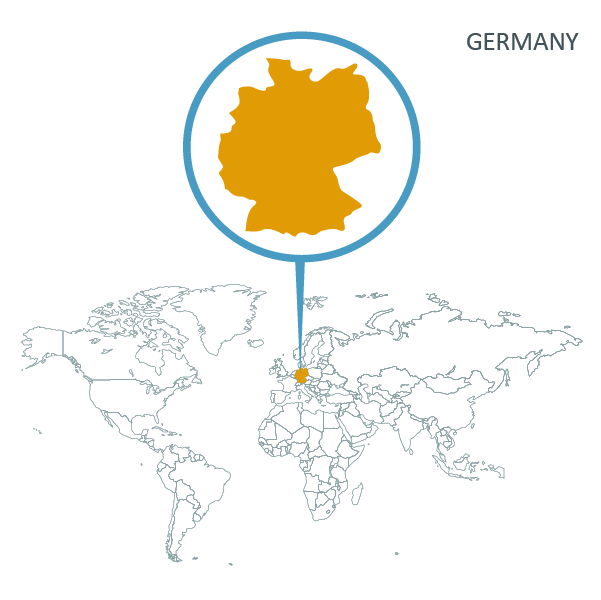
Country profile- Germany
Germany is located in the Centre-Western Europe. It is one of the most populous countries in the European Union. The United Nations Development Programme ranks Germany, 5th in terms of Human Development Index with the value of 0.936. It is ranked 20th in ‘Ease of Doing Business’ by World Bank with 5th rank in getting electricity and 4th in resolving insolvency. As per World Economic Outlook Database, 2018 estimate Germany is ranked 5th in world in GDP in PPP terms at a value of US$ 4.3 trillion while ranked 4th in GDP in nominal terms at a value of US$ 4.2 trillion. The per capita GDP of Germany in PPP terms is estimated to be US$ 52801 and in nominal terms it is estimated to be US$ 50841 in 2018 by World Economic Outlook Database. TRADE STATISTICS In 2017, Germany imported US $1.17 trillion worth of goods. Its export was over US $ 1.45 trillion in value in 2017 which accounted for 8.2 % of the total exports in the world. As per ITC trade map Germany ranks 3rd among the top world exporters, list is led by China. The top trading partner of Germany was China, followed by USA and France. India does not rank in the list of top 10 trading partners of Germany, but has a significant trade with Germany with an export by India to Germany of US$ 8.2 billion, while imports by India from Germany was at US$ 12.6 billion, resulting into a trade deficit of US$ 4.4 billion for India. GERMANY’S MERCHANDISE TRADE WITH WORLD Germany’s exports from the world have followed its path of imports throughout, as can be seen in the graph below. The country has maintained a trade surplus throughout the past decade. In 2017 it had a trade surplus of US $ 276.5 billion, the trade balance is positive but doesn’t follow an increasing trend. In the last 10 years trade surplus was highest in the year 2014 at US$ 283.2 billion, it has remained steady on an average throughout the decade. GERMANY’S EXPORT TO THE WORLD Germany’s total export in 2017 amounted to US $1.45 trillion. Its top export product at HS-6 digit level last year was motor cars and its parts, immunological products, aeroplanes and its parts and medicaments with a total share of 13% of the top 5 products in its export basket. GERMANY’S IMPORT FROM THE WORLD Germany’s import basket is primarily led by crude petroleum oil, Natural gas, Medium oils, Motor cars and its parts and Medicaments which together made up the Top 5 imports of Germany with a 10% share in its total imports (US $ 1.17 Trillion) at HS-6 digit level. INDIA-GERMANY MERCHANDISE TRADE India’s trade balance with Germany saw an (negative) upward trend till 2012 reaching a deficit of US$ 7.6 billion, declining since then. In the last decade it primarily stayed in the range of US$ 7.6 to 4.3 billion. India’s export and import followed a similar trend year on year in the last decade barring 2012 in which export from India to Germany saw a dip. INDIA’S EXPORT TO GERMANY India’s total exports to Germany amounted to US $ 8.2 billion in 2017. Its top five exports at HS-6 digit level were turbojets, motor vehicles and parts, t-shirts, singlet, other cotton vests, footwear and with outer soles of plastic or rubber and parts of tractors and motor vehicles. It amounts to 14% of the total export to Germany from India. INDIA’S IMPORT FROM GERMANY India’s total import from Germany in 2017 was US $ 12.6 billion. India’s import was dominated by Aeroplanes and parts, motor vehicle and parts, surgical and medical instruments, static convertors and parts of tractors and other appliances. The import basket of India for the products imported from Germany is highly diversified, such that the top 5 products amount to just 8% of total imports by India from Germany. Germany is India’s largest trading partner in Europe. As per MOCI report 2012-13, Germany ranks 9th among India’s 10 top trading partners, with accumulated FDI by Indian companies in Germany exceeding 6 billion Euros. Germany is the 8th largest foreign direct investor (FDI) in India. Approximately, 17% of India’s total outward foreign direct investment (FDI) projects in Europe flowed to Germany, between the years 2010 to 2016. Indian investors appreciate Germany’s high-quality infrastructure, business friendly governance, favourable R&D and innovation environment, political stability, and the workforce’s high skill and educational levels. Britain’s exit from European Union has increased Germany’s importance as a gateway to Europe. The signing of Agenda for Indo-German Partnership in early 2000s and later in 2007 a Joint Statement on the Further Development of the Strategic and Global Partnership between Germany and India cemented the India-Germany relations. Greater push for technology transfer and emulation of the successful SME model of Germany may further boost the role of Germany in India’s economic growth.
Mandatory for exports of food products to the US to put new labels
If you are exporting food products to the US, you must know that it has been made mandatory by the U.S. Food and Drug Administration (FDA) to put new labels on food products in the U.S. The changes have been made with an aim to keep the end consumer better informed about details of the food that she and her family eats so as to enable them to make healthier choices. With nearly 40 percent of American adults falling under obese category, which increases the chances of heart diseases, stroke, certain cancers, and diabetes, the new label specifications have been designed more scientifically to provide greater understanding of the links between diet and chronic disease. They enable a person or her family in counting calories by putting up details like the calories, the number of servings and the serving size in larger, bolder type. The new label specifications adjusts serving size requirements to reflect more recent consumption data, thus making the nutrition information provided for each serving more realistic. For packages that contain more than one serving, nutrition information per serving as well as per package will be available; thereby meaning while calories and nutrients are listed for one serving of ice cream, the same will also be listed for the entire container. The new label design specifications also make it mandatory to specify the added sugars content, keeping in mind the 2015-2020 Dietary Guidelines for Americans which recommends consumption of less than 10 per cent of calories per day from added sugars for the U.S. citizens. Additionally, the daily values for nutrients like sodium, dietary fiber, and Vitamin D have been updated and are used to calculate the % Daily Value (DV), printed on the label. The % DV helps a person understand the nutrition information in the context of a daily diet. The footnote at the bottom of the label also explains the meaning of the % DV. Specifications regarding information related to calories from fats have been removed in the new label design. This has been done in the light of new research as per which the type of fat consumed is more important than total fats. For example, monounsaturated and polyunsaturated fats, such as those found in most vegetable oils and nuts, can reduce the risk of developing heart disease when eaten in place of saturated and trans fats. The list of nutrient requirements too has been updated to include Vitamin D and Potassium because it has been found that the Americans normally lack adequate presence of these nutrient; Conversely, listing Vitamins A and C is no longer required, because deficiencies in these vitamins are not common, but the manufacturers of food products can still list them voluntarily. Manufacturers with $10 million or more in annual food sales have until 2020 before the new label becomes mandatory, and manufacturers with less than $10 million in annual food sales have to comply to new; regulations by 2021. Some manufacturers have already started using the new label. Due to this, presently two different versions on labels can be seen on packages in the shelves of departmental stores. As per FDA claims, the new label design has been prepared keeping the latest scientific findings pertaining to requirement of right nutrients for the body to function correctly and to fight chronic diseases like obesity, heart disease, certain cancers, and type II diabetes.
Product profile- Sesame seed
Sesame or sesamum indicum L. is commonly known as ‘Till’ in India. Sesame seed is one of the oldest oilseed crops known. It was domesticated over 3000 years ago. It was a major summer crop in the Middle East for thousands of years. Sesame has one of the highest oil contents of any seed. Sesame is drought-tolerant, primarily due to its extensive root system. However, it requires adequate moisture for germination and early growth. While the crop survives drought, as well as presence of excess water, the yields are significantly lower in either conditions. Moisture levels before planting and flowering impact yield most. It is a short duration crop grown throughout the year. TRADE STATISTICS Sesame exports sell across a wide price range. Quality perception, particularly how the seed looks, is a major pricing factor. The major sesame seed exporting nations are- The major sesame seed importing nations are – India is the leading producer and exporter of sesame seed. India produces a wide range of sesame seed varieties and grades each peculiar to the region where they are grown. Two distinct types of seed are widely recognized- the white and the black. There are also intermediate coloured varieties varying from red to rose or from brown or grey. The white and other lighter-coloured sesame seeds are common in Europe, the Americas, West Asia, and the Indian subcontinent. The black and darker-coloured sesame seeds are mostly produced in China and south east Asia. With an annual all season acreage of about 18-20 lakh hectares, India ranks first in both acreage and production (about 8 lakh MT) of sesame in the world. Sesame seeds production is primarily distributed in the states of Gujarat, West Bengal, Karnataka, Rajasthan, Madhya Pradesh, Maharashtra, Tamil Nadu and Andhra Pradesh. India’s trade trend analysis over the years India exported US$ 435.6 million while imported US$ 42.9 million of sesame seeds in 2017. India’s sesame seed export to the world saw an upward trend till 2014. In the last decade India’s export reached to US$ 813.6 million in 2014 afterwards it dipped to US$ 477.6 million in 2015 and from there on, it is picking up. As production varies considerably over the years it significantly impacts the prices. Hence the prices in the Indian markets are determined by demand and supply situation. The export trade needs a reliable forecast of production every year coinciding with the commencement of harvesting operations i.e. in the last week of September. In addition to production figures, the trade also needs information on the quality of the produce which is often adversely affected by the vagaries of weather prevailing during field, harvest and post-harvest stages of the crop. With respect to kharif-2016, a decrease by 14.1% in acreage was observed in kharif-2017 at the national level. Thus such variance adversely impact the price forecast since India is a key player in global sesame seed market. Better mechanism to forecast the production of sesame seed accurately may significantly boost India’s exports apart from the measures to boost its yield.
WTO norm and Indian practice on food security: An angle of dichotomy
The Agreement on Agriculture (AoA) was considered to be the starting point for liberalizing trade in agriculture. This framework consists of three main pillars i.e. market access, domestic support, export subsidies. Domestic support measures are basically categorized in three different general boxes, depending on their trade distortive potential. Domestic support measures in the green box shall meet the fundamental requirement that they have no, or at most minimal, trade-distorting effects on production. To meet this requirement, the AoA stipulates general and policy-specific criteria. According to the 2017 Goble Hunger Index score, India ranked 100 out of the 119 countries listed and at the same time, Food and Agriculture Organization of the United Nations (FAO) concluded that there has been a rise in world hunger. The absolute number of undernourished people, i.e. those facing chronic food deprivations has increased to nearly 821 million in 2017, from around 804 million in 2016. In the light of above conclusion, food security for mankind’s still a challenge at world level. All the institutions including the State, UNO as well as WTO are under the moral obligation to facilitate the food security for all. Overall, India’s stake is much higher than developed nations as 55 percent of Indian population is directly employed in agriculture sector. At present all support to farmers is covered by the domestic support categories which are exempt from reduction commitments under the AoA. New MSP and government plan to double the income of farmers may be critical in the context of WTO norms. Public stockholding issue is a major challenge in WTO forum and the amendment proposed by India in AoA must be considered at global platform as a desirable change. Government of India enacted National Food Security Act, 2013 with the objective to provide food and nutritional security to the citizens of India. Under this Act, Targeted Public Distribution System (TPDS) includes up to 75% of the rural population and 50% of urban population, with uniform entailment of 5 kg per person per month at the subsidized price of Rs.3, 2 and 1 per kg for rice, wheat and coarse grains respectively. The Act is now being implemented in all the States/UTs and more than 80 crore people are covered under the Act. Although developing countries have the option of a wide range of domestic support exemptions in the WTO, AoA as it stands now, Indian food security law is considered contrary to the norm of WTO. Therefore issue regarding public stockholding in WTO becomes an unresolved question at WTO level and the amendment proposed by India in AoA is considered by developing countries as a desirable change. The conflict of viewpoints of developed and developing countries is based on very clear reasons. It is thus important for us to present justification for establishing as to how Indian food security scheme is excluded from the reduction commitments. In this context present paper highlights the Dichotomy between WTO Norm and Indian Practice on Food Security and also attempts to find out a proper formula for resolving the issues regarding public stockholding for the purpose of food security at WTO level. The existing WTO disciplines on agriculture, and some proposals to strengthen these, are far from perfect. The subsidies provided to farmers include first, Non-Product Specific subsidies such as those provided for irrigation, electricity, credit, fertilizers, seed etc. and Second, Product Specific Subsidies (price support). The sum of these two is termed as Aggregate Measurement of Support (AMS), also called Amber Box. The Amber Box subsidies are considered to be trade distorting and were entitled to progressive reduction commitments, base year being 1986-87. The maximum limit for the total AMS is fixed at 5 percent of the value of domestic agricultural output for developed and 10 percent for developing countries. Clear difference between WTO norm and Indian practice exist in the context of food security and public stockholding. In reference to public stockholding, the AoA stipulates general and policy-specific criteria in Annex 2, para 3 which include First, the accumulation and holding of private or governmental stock must be purchased by the government at the current market price and not sold below the current domestic market price; Second, there must be predetermined targets for stock accumulation relating solely to food security objectives; and, Third, there must be financial transparency. In reference to expenditures on domestic food aid programs policy-specific criteria in Annex 2 para 4 includes First, to provide domestic food aid to sections of the population in need, Second, eligibility to receive the food aid shall be subject to clearly-defined criteria related to nutritional objectives; Third, food purchases by the government shall be made at current market prices; and fourth, the financing and administration of the aid shall be transparent. For the purpose of food aid sales at subsidies prices is permitted under WTO. Regardless of WTO norms, the National Food Security Act (NFSA) provides for legal rights and entitlements of up to 75% of the rural population and up to 50% of the urban population. Apart from this, all the children below the age of 14 years and every pregnant woman and lactating mother have statutory right to food under the Act. For the purpose of food aid subsidized prices are `3, `2 and`1 per kg for rice, wheat and coarse grains respectively. Food grains are procured in India at the Minimum Support Price (MSP) fixed by the Government. For Khariff Marketing Season (KMS) 2018-19, the MSP for Common and Grade ‘A’ paddy is fixed at ` 1750/- and ` 1770/- per quintal respectively. The MSP of wheat for RMS 2018-19 has been fixed at ` 1735/- per quintal. Government of India for the purpose of stockholding as well as food aid always perches the food grains at administrative price and sell below the market prices. This practice is contrary to the WTO norm. Therefore, India argue that the requirements of these policy measures under the AoA are excessively restrictive. WTO norm should not be considered just in the context of developing
Bilateral trade target of USD 15 billion will be met before 2020: Vietnamese minister Tran Thanh Nam
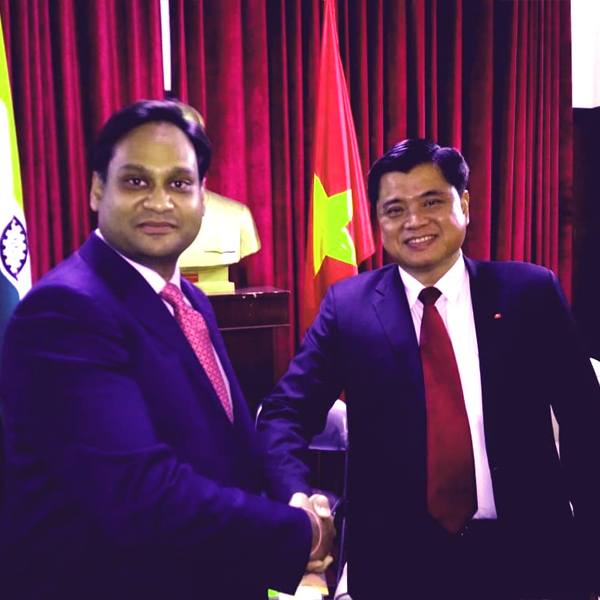
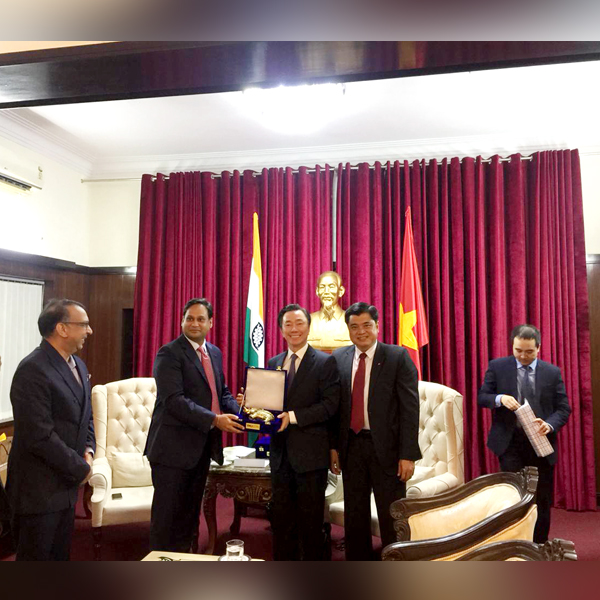
Mohit Singla, Chairman TPCI with the Head of visiting Vietnamese delegation, Tran Thanh Nam, Deputy Minister of the Ministry of Agriculture and Rural Development of Vietnam Bilateral ties between India and Vietnam have strengthened in recent years with a shared focus on regional security issues and trade. India and Vietnam have traditionally been good friends ever since Vietnam’s independence in the 70s. Defense ties have grown in recent years to include not just the traditional components in this realm of ties like exchanges and port calls but also the training of personnel, capacity-building funding and equipment, coast guard collaboration, and pacts on areas such as white shipping and outer space. Bilateral trade too has continued to grow at fast pace in recent years, particularly after the relationship between the two countries were elevated to a comprehensive strategic partnership in 2016. Target fixed is USD 15 billion worth of bilateral trade by 2020 but judging by the pace of growth so far, it is most likely that the targets will be achieved much before 2020. With a view to discuss “business opportunities and future cooperation between India and Vietnam”, a visiting high level delegation from Ministry of Agriculture and Rural Development met a delegation of senior Trade Promotion Council of India (TPCI) officials in the Vietnamese embassy recently where avenues to enhance bilateral trade between the two countries were discussed. The Vietnamese delegation was led by H.E. Mr. Tran Thanh Nam, Deputy Minister of the Ministry of Agriculture and Rural Development and was accompanied by senior government officials and 25-30 Vietnamese businessmen associated with the agriculture sector. The TPCI delegation was led by its Chairman Mr. Mohit Singla and was accompanies by Mr. Suresh Kumar Makhijani (Jt. DG), Mr. Kapil Gupta (Jt. DG), Mr. Aziz Haider (Director-CorpComm) and Mr. Sagar Bansal (Consultant). The focus, as evident, was food and agri sector in which TPCI, jointly with Department of Commerce, Ministry of Commerce & Industry, Govt of India organizes Indusfood – India’s biggest flagship event for the food & beverage industry. Mr. Tran Thanh Nam confirmed that a strong delegation from Vietnam will be visiting Indusfood to source the requirements of F& B products from India. He said he had come with a mission to promote agriculture and talked about trading of fruits, including pomegranate, mango and oranges from India and Dragon fruit, Longan fruit, Vietnamese pepper and coffee to India. Tran Tranh Nam also talked of ways and means to promote investment in Vietnam of Indian companies in Food Processing Technology and IT sectors and said great room for two way trade between the two countries has been created courtesy the advanced SEZs that Vietnam has developed. Vietnam has acquired great competence in sea-food processing and it can readily contribute its expertise in this field, if desired, said he. Tran Thanh Nam informed that Dragon fruit was Vietnam’s GI; the country was the key exporter of fruits to the U.S. Mechanisms to facilitate exchange of agriculture enterprises too were discussed. Vietnam requires technological assistance for its socio-economic and trade logistics development for which India is an appropriate partner. Both countries have identified biotechnology in agriculture and healthcare, technology for new materials, IT and electronics, super-computing, nuclear energy for peaceful uses, science and technology, remote sensing and non-traditional energy for expanding trade and investment and achieving the target of USD 15 billion worth of bilateral trade by 2020.
“India-Vietnam partnership key to peace & stability in Indo-Pacific region”
Vietnam in recent years has seen high economic growth and expansion of trade and investment, which has resulted in the country moving out of the category of Least Developed Country (LDC) and become part of new lower middle income country (MIC). It has also seen sharp truncation in poverty levels, which has resulted in bolstering the growth of GDP, currently estimated at USD 200.8 billion. India always had good relations with Vietnam which have strengthened in recently years to due to several factors. A joint sub commission of trade took place in Vietnam in 2018 where both countries discussed the ways and means to reduce trade barriers in implementation of the Framework Agreement on Comprehensive Economic Cooperation between India and ASEAN. With an aim to boost the bilateral trade between the two countries further, a high level Vietnamese delegation headed by a senior Minister of the Government visited India and as part of their official fixtures, met a TPCI delegation in the Vietnamese embassy in New Delhi. On the sidelines of the meeting, Publicity Division of TPCI got an opportunity to meet the new Vietnamese Ambassador to India Mr. Pham Sanh Chau and discussed various issues like present relations, trade and future prospects. Excerpts from the interview with Mr. Pham Sanh Chau, Ambassador of Vietnam to India: Q. How do you see India-Vietnam ties amid the changing geopolitical situation in the Indo-Pacific? Pham Sanh Chau: India-Vietnam strategic partnership is the key to maintaining peace and stability not only in SE Asia but in the entire Indo-Pacific region, as the two countries share plethora of complementarities. Bilateral trade has increased rapidly since the liberalization of the economies of both Vietnam and India but the two countries have had good diplomatic relations since 1972. In 1975 India granted the “Most Favoured Nation” status to Vietnam. Both countries signed a bilateral trade agreement in 1978 and the Bilateral Investment Promotion and Protection Agreement (BIPPA) in 1997. In 2003, both nations promulgated a Joint Declaration on Comprehensive Cooperation which was followed by Framework Agreement on Comprehensive Economic Cooperation between India and ASEAN, which further brought the two countries together. Q. What are your future plans, now that you have come to head the embassy in India? Pham Sanh Chau: I plan to make Vietnamese embassy a centre of activities. I am a good seller of my country and I will work to push trade with India in a very aggressive manner. Q. Can you elaborate how trade prospects can further be developed between the two countries? Pham Sanh Chau: Focus has to be on food and agri products. Your mango, pomegranate and oranges are complemented by Vietnamese Dragon fruit and Longan fruit. Unfortunately, your country levies 50% tariff on such exotic fruits like Dragon fruit and Longan fruit. Rs. 500 tariff is levied on every kilo of pepper coming to India. Vietnam exports $2.2 billion worth of pepper to the world but only $36 million worth of pepper comes to India. This high tariff is detrimental to end consumers in India as it makes the products expensive. It is also not consistent with WTO norms. On one hand we are talking of Comprehensive Economic Cooperation and on other hand we have such high tariffs. Likewise, tariff on Vietnamese coffee is 50% and on processed cashew nuts it is 30%. This need to be sorted out! Q. What role can TPCI play in enhancing bilateral trade between two countries? Pham Sanh Chau: It is good to know upon coming to India that TPCI is promoting food and beverage trade with India in an aggressive manner. Indusfood is a good platform to take our business relations to new heights. We import meat in large quantities from India. Fish and shrimp too are being imported. Your mango and pomegranates too have good prospect in Vietnam. On other hand, we would like to send Vietnamese Dragon Fruit, Longan Fruit, coffee and cashew nuts to India. We have invested heavily on developing SEZs in Vietnam which can get into tie-up with Indian companies. If you have any requirement for any fruit or commodity, let us know. Our farmers are very gifted, if you need anything, we can produce and export.
Why PM’s visit to Japan is crucial: Exploring food value chains and agricultural trade
As global population is expected to reach 9 billion by 2050, food needs would require a doubling of agricultural production. The need of the hour is to meet the rising demand, increase productivity, lower costs, use fewer resources such as energy, water and pesticides, and improve product quality and availability. Several companies in agri-tech and food processing technology businesses are today offering technological solutions for meeting industry demands and to provide solutions that the world is faced with. Current visit of India’s PM to Japan is strongly banking on food processing and food value chains sector which is going to bolster both the economy on mutual basis. As India is an emerging economy and a net food exporting country as well, it is indispensable for India to generate value addition as much as possible so as to escalate its exports. India’s food ecosystem offers huge opportunities for investments with stimulating growth in the food retail sector, favorable economic policies and attractive fiscal incentives. The Government of India through the Ministry of Food Processing Industries (MoFPI) is also taking all necessary steps to boost investments in the food processing industry. The government has sanctioned 42 Mega Food Parks (MFPs) to be set up in the country under the Mega Food Park Scheme. Currently, 12 Mega Food Parks have become functional. Food processing has an important role to play in linking Indian farmers to consumers in the domestic and international markets. The Ministry of Food Processing Industries (MoFPI) is making all efforts to encourage investments across the value chain. The industry engages approximately 1.77 mn people in around 38.6 thousand registered units with fixed capital of $29.7 bn and aggregate output of around $144.6 bn. Major industries constituting the food processing industry are grains, sugar, edible oils, beverages and dairy products. Food processing industry in India has two major sub-segments namely food and grocery retail (92%) and the foodservice market (8%). Major food categories such as dry food grocery, dairy products, fresh produce, perishables, and spices have a share of 34.7%, 16%, 15.6%, 8% and 6% respectively in the food processing industry. On the other hand, Japan is a saturated market. Its food processing sector does 60 per cent of its business outside Japan. But only 11 per cent of this is with India. There are only 12 Japanese companies operating in India. Japanese companies are flush with funds and are looking at investing in India. The Japanese are not looking at India as just a large market but also as a manufacturing hub. India is looking to be a sourcing destination for seafood, cashew, sesame and Darjeeling tea. It is also keen on exploring the feasibility of mergers and acquisitions of Indian companies in the food and agriculture value chain, and importing Japanese technology. Japan’s reliance on food imports is a further factor of concern, currently estimated at 60%, prompting recent government targets for boosting domestic production to 55% by 2050. Agricultural production at present is valued at around 1 trillion yen of which the government aims to increase it to 10 trillion yen by 2020, raising food self-sufficiency as a major agricultural policy. Japan can build on the benefits that it receives from the rest of the world in the form of enhanced food security by sharing its capabilities in areas where Japan plays a leading role on the world stage, such as in desalinization technology. In Japan, food security initiatives need to encompass the entire value chain because there are potential problems throughout. Driving exports to Japan and securing new technology partners for manufactures and suppliers should be the main priorities for the Indian food processing sector India’s PM’s visit to Japan aims at developing India’s food processing industry with involvement of relevant stakeholders such as local governments, private companies, SMEs and trade promotion bodies. Primary objective is to promote development of agricultural value chain and fisheries, including aquaculture, by improving the investment environment for Japanese companies, facilitate investment of Japanese companies in food value chain in the state of Maharashtra and to facilitate investment of Japanese companies in food value chain in the state of Uttar Pradesh. Let us hope Prime Minister Narendra Modi’s visit to Japan will serve as an important milestone towards developing India’s requirements related to food value chains and agricultural trade and the steps taken will lead to concrete measures to feed a greater percentage of world population.
Improving trade with neighbours through land route, top priority for Ministry of Commerce & Industry
What is common between Marks & Spencer, VIP Industries, Reliance Retail, Raymond Apparel, Aditya Birla Fashion and Retail and Puma Sports? All these companies are sourcing their requirements of apparel and related goods from neighbouring Bangladesh and transporting into India through Petrapole-Benapole (Bangladesh) border. Not just the importers into India! Companies like Tata Motors, Ashok Leyland, Hero Motorcorp, Mahindra and Mahindra, VE Commercial Vehicles (manufacturer of Volvo and Eicher Trucks) and textile manufacturer Arvind are using the integrated check post (ICP) of Petrapole-Benapole on Bangladesh border to export their products to Bangladesh. With enhanced facilities on the border, more and more traders are using the land route to import or export and the trade is flourishing, so much so that Marks & Spencer and VIP Industries paid about Rs. 11 crore each as import duty through this border ICP in 2017-18. Ministry of Commerce & Industry has recently enhanced its focus on improving trade with neighbours and is moving ahead to fast-track trade facilitation infrastructure on its border. One particular reason is the trade competitiveness with China which through its Road & Belt Initiative has enhanced its connectivity with neighbouring countries significantly resulting in easier access to its cheaper goods. China is creating a rail-link to Nepal and has ongoing road projects with almost all its neighbours and even beyond. Better connectivity with neighbouring countries, resulting in enhanced trade will also help improve ties with the neighbours, it is hoped. This step can also help land-locked countries such as Nepal and Bhutan get access to seaports. Informed Suresh Prabhu, Union Minister for Commerce & Industry in a chat with journalists recently: “The potential for India’s export to SAARC countries is $61 billion as against $14 billion now” adding further that “a healthy trade relationship with a neighbour often results in a healthier diplomatic tie, too.” With trade and other strategic interests foremost in mind, India has already transformed seven LCS, out of 109 LCSs, into ICPs. These include Attari (India-Pakistan border), Agartala (India-Bangladesh border), Raxaul (India-Nepal border), Jogbani (India-Nepal border), Moreh (India-Myanmar border) and Dwaki in Meghalaya (India-Bangladesh border) besides Petrapole ICP on India-Bangladesh border. Additionally, 13 LCS are being upgraded into ICPs at a cost of Rs. 4500 crore, which will include seven border posts with Bangladesh – Hili, Fulbari, Changrabandha, Ghojadanga, Mahadipur, Sutarkandi and Kawpuichhua – and six posts with Nepal and Bhutan. Once all the 20 ICPs (including the 13 being developed now) are ready and operational, the trade bottlenecks would be eased a lot. It is to be recalled that India has a 15,000 km land border with 7 countries viz. Pakistan, Nepal, China, Bhutan, Bangladesh, Myanmar & Afghanistan. In 2017-18, India’s trade through land borders was $13 billion, which was only 1.7% of the country’s total trade worth $769 billion. Exports through land route constituted $11.3 billion, accounting for 3.7 per cent of total exports worth $303 billion in the same period. Even in the case of Bangladesh, which is surrounded by India on three sides, about 50 per cent of export and 75 per cent of import took place through land border, out of total export to Bangladesh of $8.6 billion and import of $685 million in 2017-18. As regards to Nepal, 97% of the export worth $6.6 billion took place through land route while with Bhutan 96% of export worth $546 million took place through land route. Only 14% of the total export of $1.9 billion to Pakistan was through road. Figures are not the same for import! In 2017-18, 75% of the $685 million import from Bangladesh, 53% of the $377 million import from Bhutan, 99.8% of import worth $438 million from Nepal and 48% of $488 million worth of import from Pakistan took place through land route. ICPs on borders are a big time saver as immigration and custom officials sit in adjacent buildings for faster clearance of goods and passengers. Some of the ICPs provide amenities like parking bays, weighbridges, cargo terminals, warehouse facilities, public utility facilities, banks/ATMs, foreign exchange bureaus and cafetarias, among others. As Suresh Prabhu, the Union Minister for Commerce & Industry conveyed, the potential for India’s export to SAARC countries is $61 billion as against $14 billion at present, the trade is going to see a big boost when all the 20 ICPs become operational.
