Indian tax authorities have accused Volkswagen of paying lower import duties on car components, while the German automaker has denied all allegations.
Highlights
- India rejects Volkswagen’s defence involving rival carmakers.
- Volkswagen faces a $1.2 billion import tax demand.
- Authorities allege the company paid lower customs duties on car components.
- Volkswagen claims rival automakers follow similar import practices.
- Bombay High Court is expected to deliver a key ruling on November 30.
- Volkswagen holds around 2% of India’s automobile market.
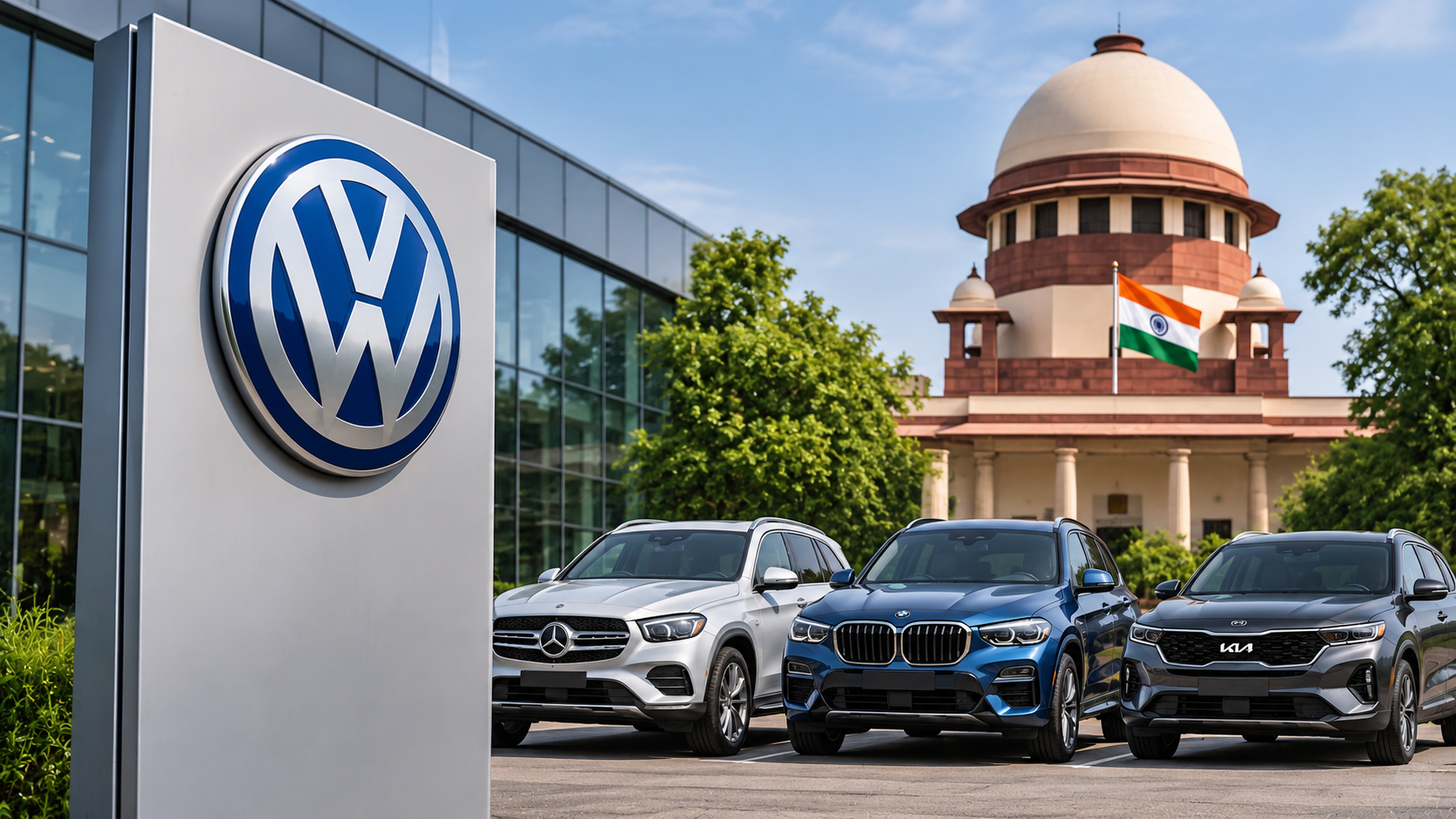
German automobile giant Volkswagen is facing mounting legal challenges in India over a $1.2 billion customs duty dispute. Indian tax authorities have rejected the company’s arguments that rival automakers, including Mercedes-Benz, BMW and Kia, follow similar practices while importing vehicle components, according to a Reuters report.
The dispute dates back to 2024, when Indian authorities accused Volkswagen of importing components of Volkswagen, Audi and Skoda vehicles through separate shipments to pay lower customs duties.
What is the tax dispute?
According to tax authorities, Volkswagen imported hundreds of vehicle components separately and paid an import duty of around 10% before assembling them into cars in India.
However, authorities maintain that these imports should have been classified as complete knocked-down vehicle kits, attracting customs duties of 30% to 35%.
The government has alleged that Volkswagen paid duties ranging from 5% to 15% over a period of 12 years by classifying its imports as individual components.
Volkswagen has denied the allegations and challenged the tax demand in the Bombay High Court.
Why are Mercedes, BMW and Kia involved?
In its defence, Volkswagen argued that several competing automobile manufacturers follow comparable component import practices in India.
However, Indian authorities rejected the comparison, arguing that Volkswagen relied on incomplete import data of competing manufacturers.
The government maintained that companies such as Hyundai and Mercedes-Benz comply with applicable customs regulations.
Kia also told Reuters that its component imports comply with applicable laws.
Disagreement over Mercedes-Maybach imports
The import of components for Mercedes-Maybach luxury vehicles has emerged as another point of disagreement.
Tax authorities argued that Mercedes-Benz pays customs duties of 30% to 35% when importing complete vehicle kits containing pre-assembled engines or transmission systems.
Volkswagen, however, maintained that expensive luxury vehicles such as Maybach cannot be directly compared with its relatively affordable models involved in the dispute.
Crucial court ruling on November 30
The Bombay High Court is expected to decide on November 30 whether tax authorities are justified in examining Volkswagen’s imports spanning 12 years.
The decision could mark a significant development in the legal battle involving one of India’s largest import duty demands.
Volkswagen, which accounts for approximately 2% of India’s automobile market, has described the dispute as critical to the future of its Indian operations. The allegations remain contested, and the final tax liability has yet to be determined.
Source: Reuters, Business Standard (November 29, 2026).