The government has approved six brownfield gas-based urea projects to expand domestic fertiliser production, modernise ageing plants and reduce dependence on imports.
Highlights
- Six brownfield urea projects worth approximately ₹54,000 crore have received approval.
- The projects were cleared under the National Investment Policy for Urea 2026.
- The approved projects are located in Tamil Nadu, Punjab, Uttar Pradesh, West Bengal and Rajasthan.
- Each project is estimated to involve capital expenditure of around ₹9,000 crore.
- India consumes approximately 400 lakh tonnes of urea annually.
- Domestic urea production reached 293.30 lakh tonnes in 2025–26.
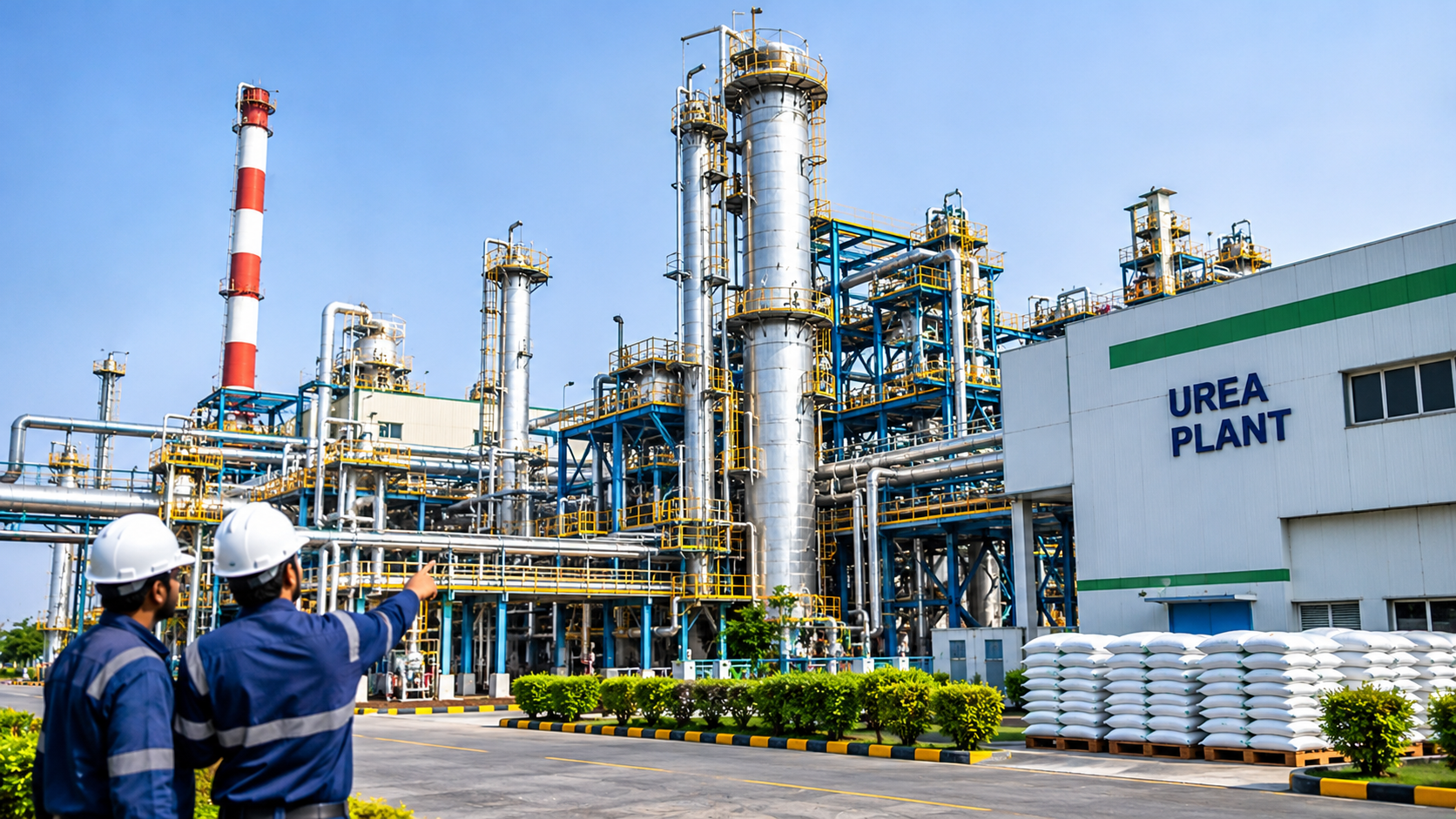
The government has cleared six brownfield gas-based urea projects involving an estimated investment of ₹54,000 crore under the National Investment Policy for Urea 2026 (NIPU-2026). The approvals aim to increase domestic fertiliser production, modernise ageing manufacturing facilities and reduce India’s dependence on imported urea.
According to a senior Fertiliser Ministry official, the six projects have been selected from 18 proposals received under the new investment policy. The approved projects cover public sector, private sector and cooperative enterprises.
The projects are located at Madras Fertilizers in Chennai, National Fertilizers Limited (NFL) in Nangal, KRIBHCO’s facility in Shahjahanpur, Matix Fertilizers in Panagarh, Chambal Fertilisers and Chemicals in Gadepan, and Indian Farmers Fertiliser Cooperative’s project at Jagdishpur.
Six Projects Receive Government Approval
The approved projects include both replacement of older manufacturing units and expansion of existing facilities.
Madras Fertilizers’ Chennai project involves replacing a unit that is more than 60 years old. The existing facility has higher production costs, greater energy consumption and safety-related concerns.
At Nangal in Punjab, National Fertilizers Limited plans to replace a plant established in 1978. The existing facility has a capacity of 4.73 lakh tonnes annually, while the proposed modernised unit is expected to have a capacity of 12.7 lakh tonnes per year.
KRIBHCO’s Shahjahanpur project involves expanding a cooperative fertiliser unit commissioned in 1995.
Matix Fertilizers plans to strengthen its Panagarh facility in West Bengal. The state currently has only one urea manufacturing plant, and the project is expected to support its fertiliser requirements.
Chambal Fertilisers will expand its Gadepan complex in Rajasthan, which has been operational since 1994. The sixth project, at Jagdishpur in Uttar Pradesh, proposes an additional capacity of 12.7 lakh tonnes annually.
Investment Policy Aims to Strengthen Domestic Production
The National Investment Policy for Urea 2026 was approved by the Cabinet Committee on Economic Affairs on July 15 and notified on July 30.
The policy seeks to attract fresh investment in both greenfield manufacturing facilities and brownfield expansion projects.
The government received 18 proposals under the policy, of which six major brownfield projects have now been taken forward.
Brownfield projects can benefit from existing land, infrastructure, utilities, logistics facilities and technical manpower. This can help reduce project execution time and improve cost efficiency compared with establishing entirely new facilities.
Each of the six approved projects is estimated to require capital investment of around ₹9,000 crore.
Modernisation of Ageing Fertiliser Plants
The government has highlighted the need to modernise older urea manufacturing units because of their higher energy consumption, operating costs and process-safety risks.
The Nangal facility, for example, currently operates at an energy consumption level of 6.498 Gcal per tonne. This is higher than the weighted industry average of 5.95 Gcal per tonne and the new energy norm of 5 Gcal per tonne.
Replacing outdated equipment and introducing modern production technology is expected to improve operational efficiency and reduce energy requirements.
India Seeks to Reduce Urea Import Dependence
India consumes approximately 400 lakh tonnes of urea annually, making domestic production an important component of the country’s agricultural supply chain.
Domestic urea production increased from 225 lakh tonnes in 2014–15 to a record 314.07 lakh tonnes in 2023–24. Production stood at 293.30 lakh tonnes in 2025–26.
The country’s indigenous reassessed urea production capacity has also increased, rising from 207.54 lakh tonnes annually in 2014–15 to 269.42 lakh tonnes in 2026–27.
The government expects additional manufacturing capacity and expansion projects to reduce reliance on imports and help conserve foreign exchange.
Policy Offers Investment Incentives
To encourage investment, NIPU-2026 provides a return on equity ranging from 12% to 16%, along with a foreign exchange rate mitigation mechanism.
Under the mechanism, the foreign exchange component is converted into rupees after four years at prevailing exchange rates.
The government estimates that brownfield advantages could generate annual savings of around ₹225 crore, translating into approximately ₹1,800 crore over eight years.
The policy also separates fixed costs from variable or energy costs. It keeps the energy cost component unchanged while reducing fixed costs by around 8%, resulting in an estimated 14% reduction in concession prices for greenfield and brownfield projects.
Additional Fertiliser Projects in the Pipeline
Apart from the six approved projects, two more major urea manufacturing projects are under execution.
The Talcher Fertilizer Project in Odisha is being developed through the coal gasification route and is expected to be completed by December 2027.
Another project is being developed by Assam Valley Fertilizers and Chemicals Company at Namrup. Its announcement was made on March 19, 2025.
The latest approvals represent another step towards expanding domestic fertiliser manufacturing capacity and improving the long-term availability of urea for Indian agriculture.