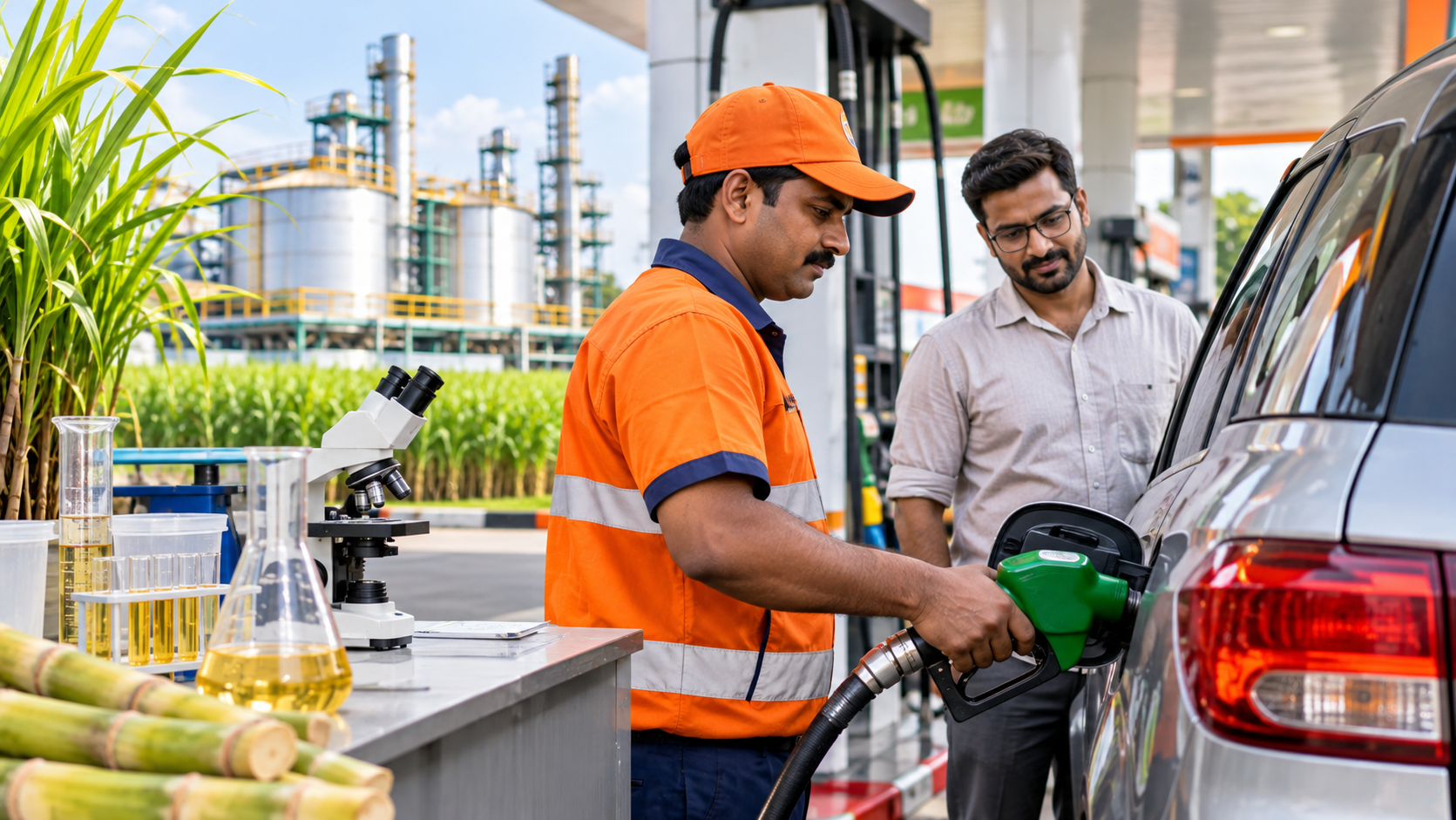
The government has defended India’s E20 petrol programme after tests of 893 fuel samples across 27 States and Union Territories found ethanol levels within prescribed standards. All 56 samples tested in Karnataka were also compliant, contradicting the state government’s claim that some petrol contained 26-31% ethanol.
New Delhi, November 7 — The government has defended the 20% ethanol-blended petrol (E20) programme, saying tests conducted on 893 samples collected across 27 States and Union Territories found the fuel compliant with prescribed quality standards.
The Ministry of Petroleum and Natural Gas said samples tested by public sector oil marketing companies Indian Oil Corporation (IOC), Bharat Petroleum Corporation (BPCL) and Hindustan Petroleum Corporation (HPCL) contained ethanol within the prescribed 19-21% range under BIS specification IS 17021.
In Karnataka, all 56 samples tested across different locations and the three oil marketing companies recorded ethanol content between 19% and 20%, with an average of 19.30%.
Karnataka had claimed ethanol content of up to 31%
The findings contradict a recent statement from Karnataka’s Department of Food, Civil Supplies, Consumer Affairs and Legal Metrology, which claimed that petrol samples collected from certain retail outlets contained 26-31% ethanol.
The three OMCs have questioned the sampling and testing procedures used in Karnataka’s October exercise.
According to the source, the companies said they had not received corresponding retention samples, complete outlet-wise details or laboratory reports despite seeking them.
They have called for joint sampling and independent testing using prescribed procedures.
Questions raised over testing method
The OMCs also questioned certificates issued by a third-party laboratory, saying they did not specify important technical details regarding the testing procedure.
Under IS 17021:2018, as amended in August 2025, ethanol content must be determined through prescribed testing methods.
The companies also pointed to differences in reported density readings, arguing that higher ethanol content would ordinarily be expected to increase the density of the petrol blend.
Govt rejects ₹1.01 lakh crore consumer-loss estimate
The government and oil companies also challenged estimates suggesting E20 petrol could lead to around ₹62,000 crore in annual mileage losses and ₹39,000 crore in vehicle repair costs, taking the combined burden to approximately ₹1.01 lakh crore.
The Petroleum Ministry cited studies indicating that vehicles calibrated for E20 could experience a mileage reduction of around 1-2%, while some other vehicles could see a decline of 3-6%.
OMCs said a blanket assumption of a 10% mileage loss across all vehicles was not scientifically established.
According to the ministry, India’s ethanol programme has generated more than ₹1.97 lakh crore in foreign exchange savings since the 2014-15 ethanol supply year, substituted around 316 lakh metric tonnes of crude oil and resulted in payments of more than ₹1.66 lakh crore to farmers.
The three oil companies have said they are willing to participate in joint sampling and testing with Karnataka authorities, adding that any deviation established through prescribed procedures would be dealt with under applicable guidelines.